Research
The Hybrid Autonomous Dealer
A Practical Operating Model for Governed Automation in 21st Century Automotive Retail
Jason Bennick and Wes Reid
September 30, 2026
RESEARCH WHITE PAPER
First Publication | Enterprise
Contents
- Abstract
- 01 Purpose And Evidence Base
- 02 From Transaction Computing To Connected Retail
- 03 Consumer Expectations And The AI Transition
- 04 The Dealership Technology Crossroads
- 05 What AI Capability Actually Means
- 06 Defining the Hybrid Autonomous Dealer
- 07 Three Core Operating Responsibilities
- 08 The Dealer Data Universe
- 09 Five Layers From Data to Action
- 10 The Dealer Agent in Daily Work
- 11 Coordinating the Customer Lifecycle
- 12 Trust And Bounded Commercial Authority
- 13 The Stack Audit as an Adoption Blueprint
- 14 Cost and Application Reduction Through Consolidation
- 15 From Dealer to Hybrid Autonomous Dealer Group
- 16 Deployment and Operational Acceptance
- 17 Measurement and Research Agenda
- 18 Conclusion
- References
Abstract
The rapid expansion of artificial intelligence in automotive retail has created a need for a coherent dealership operating model that connects technological capability with human expertise. Building on the industry’s progression from transaction computing to customer relationship management and digital engagement, this white paper examines the convergence of changing consumer expectations, expanding AI adoption, and fragmented dealership technology. It synthesizes industry statistics, consumer and dealer surveys, technical research, interoperability standards, and governance guidance to propose the Hybrid Autonomous Dealer: a dealership in which connected systems execute defined, repeatable workflows with bounded independence, while accountable personnel retain responsibility for judgment, customer relationships, consequential commercial decisions, and physical vehicle work. The model adopts an indicative 80:20 automation-to-human principle for eligible recurring information and engagement workflows. This ratio is a planning heuristic requiring dealership-level validation, rather than a measured industry standard, a prescribed staffing ratio, or an assumption that physical sales and service activities can be predominantly automated. Its objective is substantial operating leverage: technology handles routine detection, preparation, coordination, and execution, allowing personnel to focus on complex problems, specialized work, and high-value customer interactions.
The proposed architecture assigns complementary responsibilities to three core systems: the Dealer Management System, the Customer Relationship Management system, and a Dealer Engagement Operating System (DEOS). These systems supply a governed Dealer Data Universe, connecting authorized operational records, customer information, and engagement history while preserving source authority, identity, permissions, and data freshness. Five architectural layers are introduced: data foundation, indexing and retrieval, inference, orchestration, and conversational interface. Collectively, these enable a role-aware machine learning Dealer Agent to provide evidence-backed answers and initiate authorized actions.
The DEOS coordinates both internal employee interaction and external customer engagement across an illustrative taxonomy of 22 lifecycle touchpoints, using configurable channels, sequences, eligibility rules, and escalation procedures. The paper translates this architecture into departmental responsibilities across Sales and BDC, Finance and Insurance, and Service. It also describes an organizational structure supported by AI operations oversight, data analysis, relationship advisors and qualified specialists. Reliable transfers between automation and personnel, customer consent, accurate commercial representations, security, auditability, and recovery are treated as essential operating capabilities. The Hybrid Autonomous Dealer Group extends these principles through shared definitions and coordinated intelligence while preserving store-level authority and appropriate information boundaries.
Adoption begins with a Stack Audit that maps applications, costs, overlapping workflows, and integration dependencies to establish a consolidation blueprint. Hypothetical scenarios illustrate recurring savings of $7,500 per month for one dealership and $900,000 annually across ten similarly situated stores, subject to verified functional replacement and transition costs. The paper concludes that a useful dealership benchmark should be defined by coordinated execution, reduced application burden, demonstrated economic value, and effective human accountability. Phased deployment and explicit measurement are necessary to establish where the proposed model improves efficiency, customer experience, and operating performance.
01 Purpose And Evidence Base
This paper is for dealer principals, dealership group executives, operating leaders, technology architects, industry researchers, dealership and automotive marketing agencies, and related OEM stakeholders. Its central question is how a dealership can absorb advances in AI without transferring control of its operations, customer relationships, or commercial commitments to loosely connected automation. The analysis focuses on United States franchised light-vehicle retail, while recognizing that independent retailers and other markets may adopt similar architectural principles under different operating and legal conditions.
The paper is a narrative research synthesis and a proposed reference model. It combines industry statistics, consumer and dealer surveys, automotive standards, technical research, consumer reporting, and the authors’ supplied operating concepts. Sources were reviewed through September 30, 2026. Numerical findings retain their reporting period and surveyed population. Vendor statements reflect what a company publicly describes, not independently proven product performance. No original representative dealer survey, time-and-motion study, or controlled deployment trial was conducted for this paper.
The authors’ unpublished I REVLAB INC design materials and proprietary report establish the framework’s terminology and intended capabilities shared in this white paper.2 Practitioner commentary informed the questions investigated but was not treated as empirical evidence. The diagrams present a reference architecture. Implementation effectiveness remains a subject for validation.
Disclosure is necessary to distinguish an analytical tone from institutional independence. The proposed framework arises from commercial platform development associated with I REVLAB INC, and Jason Bennick and Wes Reid have a leadership and technology interest in that business. The authors’ lifetime industry experience motivates the proposal but does not substitute for external validation. No vendor endorsement, peer review, or independent certification of the framework is implied.
The modifier “hybrid” explicitly identifies human participation as a permanent design feature of this reference model. Autonomous terminology already has other industry uses and lacks a single, uniform meaning. The paper does not equate every existing autonomous proposition with a human-free store. There is also a boundary around originality. Nexbotix published a guide titled The Autonomous Dealership in February 2026, and existing automotive vendors describe AI operating systems and data-driven engagement platforms.3 This paper therefore introduces the authors’ particular combination of operating definitions, three core roles, five architectural layers, and an audit-led adoption method. It does not claim first use of the word autonomous, exclusive ownership of the general concept or proof that no comparable system exists.
02 From Transaction Computing To Connected Retail
The history relevant to this proposal is a progression in software responsibilities. Dealer systems first made transaction administration more tractable: accounting, inventory, parts, service, and financial records could be handled through shared computing rather than disconnected paper processes. CDK describes a DMS lineage extending more than 50 years.4 That history matters because the dealership already had technology-mediated operations before generative AI. Treating the earlier dealership as entirely manual obscures the continuity between established automation and today’s AI-assisted workflows.
Customer and opportunity management added a second responsibility. Lead records, salesperson assignments, contact histories, and pipeline tasks became operational assets. Websites, digital advertising, and online shopping tools then broadened the dealership’s customer-facing perimeter. The resulting environment could contain capable systems with different databases, identifiers, and owners. An employee might still have to translate a service event into a marketing audience or reconcile a conversation with the sales record. The problem is the handoff between responsibilities, even when each application performs its own job well.
Interoperability has long been an industry objective. Standards for Technology in Automotive Retail, founded in 2001, began with open XML messages for dealer-to-manufacturer processes including parts orders, sales leads, and credit applications.5 In January 2026, STAR announced a Retail Automotive Domain Model intended to standardize operational data definitions across DMS, OEM, and third-party systems.6 These initiatives establish that common data language and connected workflows are substantive industry work already in progress.
A useful historical interpretation is therefore cumulative rather than replacement-based. Transaction systems established records; customer systems organized relationships; digital channels distributed interactions; AI now expands the ability to interpret language, generate content, and carry out sequences of work. The new architectural task is to connect these responsibilities without weakening the systems that remain authoritative for operational transactions. KPMG’s 2023 connected-enterprise analysis similarly linked customer experience, integrated operations and digital architecture across the automotive value chain.7
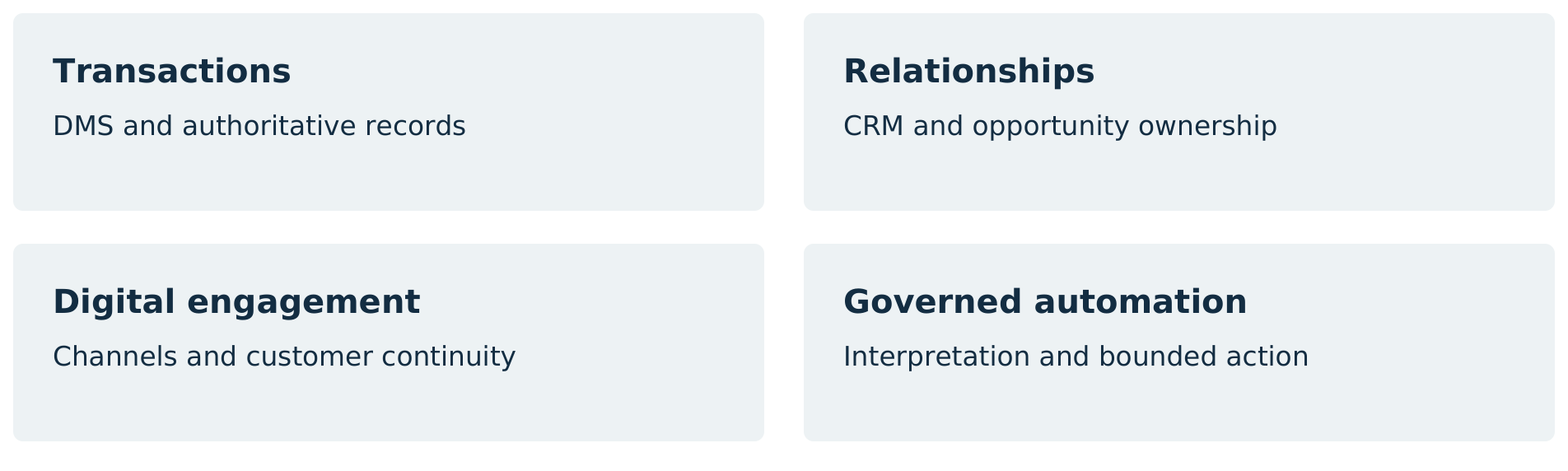
Figure 1. Evolution of operating responsibilities. Conceptual synthesis; stages overlap and do not imply universal adoption dates.
The three-system model assigns operating responsibilities rather than prescribing three products. Websites, payments, financing, OEM portals, security, and specialist tools remain necessary where their functions are not replaced.
03 Consumer Expectations And The AI Transition
The consumer environment has changed beyond automotive retail. Pew Research Center’s February 2026 survey of 5,119 U.S. adults found that 49 percent reported using AI chatbots and 24 percent used them daily. Reported use included ChatGPT, Gemini, Copilot, Grok, and Claude; brand-use percentages overlap because respondents can use several products. Adoption also coexisted with skepticism about privacy and AI’s wider impact.8 However, consumers having familiarity with a conversational interface does not necessarily establish their willingness to accept an unsolicited AI or automated (sales) call.
The dealership implication is broader than putting a chatbot on a website. Consumers can arrive with AIassisted comparisons, financing questions, and interpretations of service needs. They also expect continuity when moving from a digital exchange to a salesperson or service advisor. A dealer response must be accurate in the context of that specific store’s inventory, prices, policies, and appointment capacity. A generic model’s ability to produce persuasive language is insufficient to establish those facts.
Cox Automotive’s 2025 Car Buyer Journey findings show both AI use and continued demand for physical interaction. 19% of all buyers and 25% of new-vehicle buyers reported using AI sites or AI-generated overviews. Only 7% reported buying entirely online, while 63% preferred an omnichannel process combining online and in-person steps.9 The practical interpretation is that AI can support a hybrid buying journey. The authors note that these observations do not justify predicting the disappearance or permanence of human retail.
By mid-2026, adoption and operating readiness were diverging. Cox’s AI in Auto Retail Tracker reported that 82% of surveyed dealers used AI, yet roughly one-third lacked clear impact measurement. Only 22% of AI users reported sales and revenue growth from AI. Its Q2 sample included 483 franchise and independent dealers and 1,502 in-market consumers; the publication also incorporated a Q1 wave.10 These are self-reported findings for that sample, not a census of franchised dealerships or a causal estimate of AI returns.
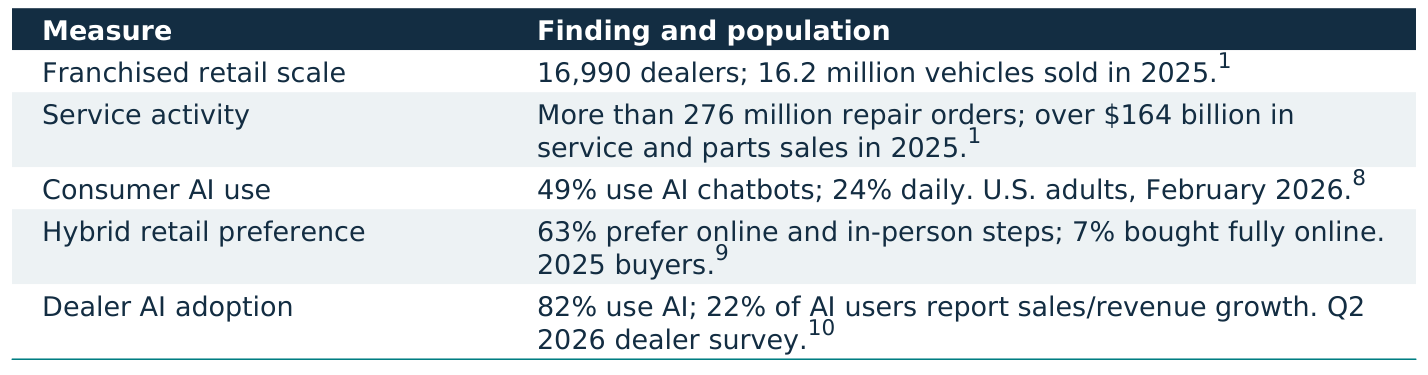
Table 1. Selected market and adoption evidence
| Measure | Finding and population |
|---|---|
| Franchised retail scale | 16,990 dealers; 16.2 million vehicles sold in 2025.1 |
| Service activity | More than 276 million repair orders; over $164 billion in service and parts sales in 2025.1 |
| Consumer AI use | 49% use AI chatbots; 24% daily. U.S. adults, February 2026.8 |
| Hybrid retail preference | 63% prefer online and in-person steps; 7% bought fully online. 2025 buyers.9 |
| Dealer AI adoption | 82% use AI; 22% of AI users report sales/revenue growth. Q2 2026 dealer survey.10 |
View Table 1 as printed
The convergence creates two different obligations.
a. Externally, the dealership must make interactions easier and more trustworthy.
b. Internally, it must give employees reliable context and reduce unnecessary administrative work.
A faster reply that misstates stock availability or repeats an already declined offer meets neither obligation. The operating model must evaluate the complete interaction, including the next human handoff.
Channel preferences differ by customer and task. They should be observed or requested rather than inferred from age. Familiarity with digital tools does not imply a preference for automated interaction at every step.
04 The Dealership Technology Crossroads
Adding a point solution can improve a specific process while increasing coordination work elsewhere. A sales follow-up agent, service reminder service, and equity campaign may each identify a legitimate reason to contact the same person. Without a shared policy, that customer can receive conflicting messages or excessive contact. Different systems may also use inconsistent definitions of a lead, appointment, or completed sale. Local success metrics can conceal a poor overall experience.
The external research supports a coordination problem without establishing a universal application count or spending excess. KPMG’s 2025 Global Automotive Executive Survey covered 775 global executives and recommended auditing digital and physical touchpoints for duplication and integrating systems around a customer view.11 Its 2026 automotive technology report, based on 258 technology leaders from large organizations across manufacturing, suppliers, and mobility, emphasizes legacy constraints and common architectures.12 Though relative, the authors note that neither sample should be presented as a direct measurement of the average U.S. dealer’s software stack.
Epsilon’s 2026 marketing benchmark provides adjacent evidence. The report identifies 257 respondents across five U.S. industries, and its methodology describes an online survey of about 250 marketers conducted in May 2026. 45% cited data quality as a technical challenge and 50% reported difficulty evaluating vendors and tools that deliver value. Only 2% allowed agents to run without human intervention; 76% required sign-off before execution.13 These findings support attention to data and oversight, but are not necessarily dealershipspecific prevalence estimates.
Consequently, the paper treats technology fragmentation as a condition to investigate at each dealership. It does not assume every store uses dozens of redundant products, or that every vendor fails to audit its customers’ workflows. More practical questions include which processes overlap, which records disagree, who controls an action, and whether a proposed replacement preserves essential functions at a lower total cost.
The procurement shift is from feature acquisition to responsibility assignment. A dealer must identify the owner of each workflow from trigger through completion. Who decides that a service customer is eligible for outreach? Which system checks preferences? Which system captures the reply? Who handles a dispute? Unless these answers are explicit, adding more intelligence can simply accelerate an incoherent process.
05 What AI Capability Actually Means
AI should be described by the work it performs. Machine learning can estimate a propensity or classify an event. Natural language processing can interpret a request or summarize a conversation. Generative AI can draft text, synthesize speech, or produce visual assets. An agent combines reasoning or decision logic with tools to pursue a bounded objective.
Deterministic software still performs functions that require exact rules, such as permission checks, financial calculations, and transaction validation.
An AI-powered label does not establish autonomy. A tool that suggests a response still typically depends on an employee to review and send it. However, a preconfigured sequence can operate autonomously within its limited domain even if it does not use a large language model at every step. The meaningful distinction is which workflow steps the system can execute reliably, with what context, under whose authority, and with what recovery behavior.
Public vendor documentation demonstrates that the market is already broader than isolated chat widgets. Impel describes an AI operating system spanning sales, service, marketing, and customer interactions.14 Fullpath describes a GPT-based conversational integration connected to dealership data and a proprietary data layer, alongside its CDP offering.15 These are vendor descriptions, not independent capability tests. While prior experience with these vendors has revealed a lack of any proprietary generative AI technology, a claim that such companies have no material AI or ML intellectual property would be unsupported.
Use of a third-party foundation model does not by itself determine the value or originality of an application. Useful engineering can reside in domain schemas, retrieval, workflow logic, evaluation, integrations, governance, and user experience. Conversely, model ownership does not guarantee reliable execution. Procurement should test the complete system rather than infer quality from whether a vendor trained a foundation model.
The relevant evaluation is demonstrable behavior. A system should show where a fact came from, what data it can read, which tools it can invoke, what approval is needed, and how a customer response changes subsequent action. A convincing demonstration should include failure cases: stale inventory, a withdrawn consent, conflicting customer identifiers, an unavailable appointment, and an attempt to induce an unauthorized price commitment.
06 Defining the Hybrid Autonomous Dealer
A Hybrid Autonomous Dealer is defined here as a dealership that uses connected, governed systems to execute eligible recurring information and customer engagement workflows with bounded independence, while accountable personnel retain oversight, exception handling, consequential decisions, and physical customer and vehicle work.
Autonomy belongs to defined workflows, not to an unrestricted digital entity. A routine reminder can operate within approved rules. A contested repair recommendation, negotiated price, or financing decision requires different authority and expertise. The label should describe a documented operating capability rather than a marketing promise of an unmanned store.
The proposed 80:20 Principle expresses the intended allocation of effort within suitable workflows: technology performs most recurring detection, preparation, coordination, and routine execution, while people concentrate on judgment, relationships, and exceptions. It is not the Pareto principle applied as empirical proof. It does not mean 20 percent of the current workforce is sufficient, 80 percent of employees should be removed, or physical service tasks fall inside the automation denominator. Measurement requires that denominator to be defined. A dealership could catalog eligible workflow steps, estimate baseline human minutes, then measure assisted and fully automated execution, review time, exceptions, and rework. Two separate metrics are needed: automated completion of eligible workflow instances and net human time saved after oversight. A high automated completion rate can coexist with modest labor savings if every completion needs substantial checking.
Research outside automotive retail cautions against translating capability into blanket staffing claims. Brynjolfsson, Li and Raymond’s 2023 study of 5,179 customer support agents found an average productivity improvement of approximately 14% from AI assistance, with heterogeneous effects by worker experience.16 That result supports the possibility of augmentation; it does not estimate dealership staffing requirements or validate an 80 percent automation target.
Departmental allocation of work
The 80:20 Principle architecture allocates work according to repeatability, consequence, and customer need. High-volume tasks with reliable inputs and limited discretion are candidates for bounded automation. Tasks requiring physical inspection, negotiation, empathy, professional judgment, or binding authority remain assigned to qualified people.
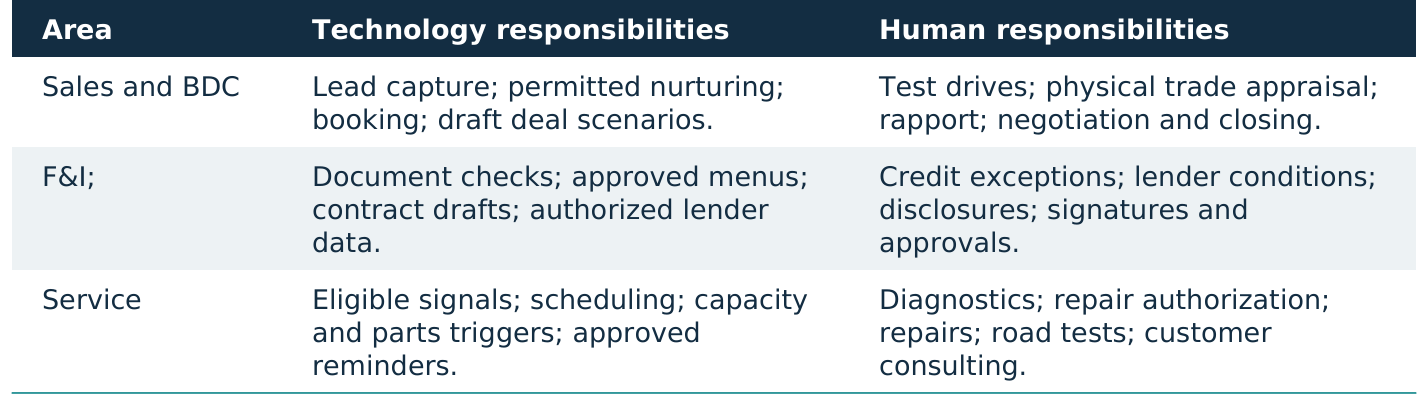
Table 2 translates that principle into departmental responsibilities. Its columns describe intended work allocation, not measured automation percentages within each department.
Table 2. Proposed departmental allocation of eligible work
| Area | Technology responsibilities | Human responsibilities |
|---|---|---|
| Sales and BDC | Lead capture; permitted nurturing; booking; draft deal scenarios. | Test drives; physical trade appraisal; rapport; negotiation and closing. |
| F&I | Document checks; approved menus; contract drafts; authorized lender data. | Credit exceptions; lender conditions; disclosures; signatures and approvals. |
| Service | Eligible signals; scheduling; capacity and parts triggers; approved reminders. | Diagnostics; repair authorization; repairs; road tests; customer consulting. |
View Table 2 as printed
In sales and the business development center, the technology layer can capture leads, resolve identities, nurture eligible prospects across approved channels, and book available sales appointments. Given the advances in AI in CRM technology, such as with DriveCentric™, these functions become largely automated and driven through bounded processes for dealerships.
Overnight desking for sales should mean preparing a deal scenario from current inventory, authorized prices, and validated calculation tools. A system should identify assumptions and route a proposed offer for approval. It would not necessarily and accurately independently promise a final trade value, lender approval, or commercial terms outside delegated limits. Live lender stipulations or conditions can be retrieved and organized only through authorized integrations; missing conditions and exceptions remain accountable human work.
In F&I, document preparation and completeness checks can reduce administrative effort. Approved menu presentation may be supported by disclosed needs, eligibility, and consistent product rules. Predictive buyer profiles do not establish suitability or justify manipulating prices or terms. Contract generation must use approved templates and verified inputs, with exceptions reviewed by qualified F&I personnel. Signature collection can be supported electronically where permitted, but the system cannot supply customer consent, substitute for a required signatory, or guarantee legal compliance. Financial information also requires safeguards appropriate to the dealer’s role.17 In Service, authorized telemetry or maintenance signals can initiate scheduling proposals, while capacity tools can coordinate bays, technicians, and parts. Telemetry availability, customer permission, OEM interfaces, and compatible vehicles are prerequisites. Parts triggers should observe approval thresholds and actual inventory. A declined-work reminder can include an approved offer when appropriate; an automatic discount is not the default response to every declined repair. Diagnostics, repair authorization, hands-on work, and quality control retain their separate professional responsibilities.
Organization and human accountability
The organizational shift changes how work is distributed, not who holds legal authority. A computational backbone handles routine coordination continuously, supported by monitored infrastructure and recovery procedures. Service and sales executives, or independently appointed AI operations managers and data analysts, supervise data quality, workflow performance, and exceptions. Service and sales representatives concentrate on customer needs that benefit from human judgment and continuity. Department managers, technicians, controllers, and accountable leadership remain essential to the model.
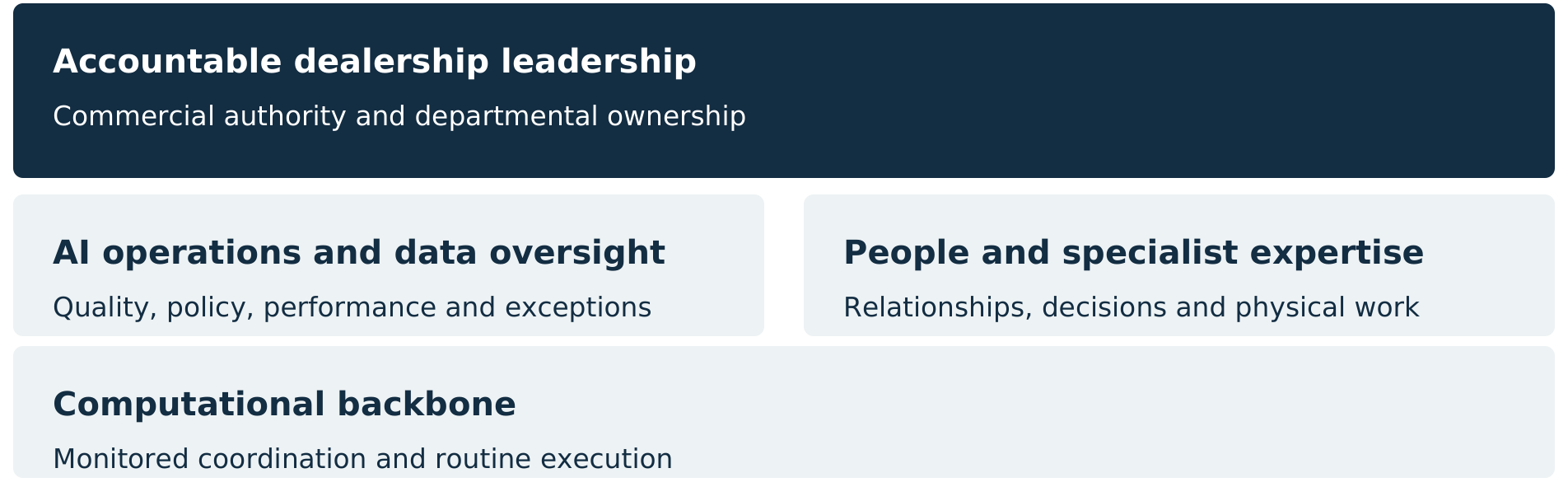
Figure 2. Proposed hybrid operating organization. Technology supports oversight and relationship work; executive and departmental authority remains with people.
Using AI to functionally operate requires more than prompt editing. Responsibilities include maintaining approved workflow settings, testing model and connector changes, monitoring conversation drop-off and failed transfers, inspecting audit records, reconciling realized margins, and reviewing unintended outcomes.
A CUI (Conversational User Interface, such as a ChatGPT or Claude prompt interface) can assist these activities, but production changes require version control, appropriate approval, and rollback. Operators should not improvise material pricing or consent rules through unrestricted prompts. NIST’s emphasis on governance, monitoring, and human interaction informs these proposed responsibilities.18 A smaller dealership may assign these duties to trained existing managers or a shared service. A dealer group may centralize specialist oversight while keeping local managers responsible for capacity and customer outcomes. Neither arrangement removes the need for sufficient routine personnel to handle simultaneous showroom visits, service consultations and exceptions. Service and sales representatives should be available when a customer asks for a person, becomes confused, expresses dissatisfaction or needs specialized help, as well as when ready to transact. Empathy, product expertise and continuity become selection and training priorities; higher pay and lower headcount are possible organizational choices, not guaranteed consequences.
07 Three Core Operating Responsibilities
The DMS is recognized as the operational system of record for the domains it actually administers. These include repair orders, parts, vehicle inventory, accounting, and all dealership transactions. The reference Hybrid Autonomous Dealership model favors secure, remotely accessible, API-enabled systems; an entirely web-based interface is a design preference, not sufficient evidence of interoperability or autonomy. Available read and write interfaces must be verified for the particular DMS deployment. The CRM manages customer sales opportunities, contact history, lead ownership, and sales pipeline activity. AI assistance can improve prioritization and followup, but the CRM still has a distinct job: preserving accountable relationship workflows. The reference Hybrid Autonomous Dealership model does not transfer lead ownership to an engagement platform simply because that platform sends the most messages.
The Dealer Engagement Operating System, abbreviated DEOS, coordinates the decision and action cycle for engagement. It observes approved signals, applies eligibility and consent rules, prepares content, selects an authorized channel, executes a communication, interprets the response, and updates or routes the next step. It also supplies internal access to engagement intelligence and bounded task execution. This is a concluded functional category as a third requirement to conclude the “three core operating” systems and responsibilities.
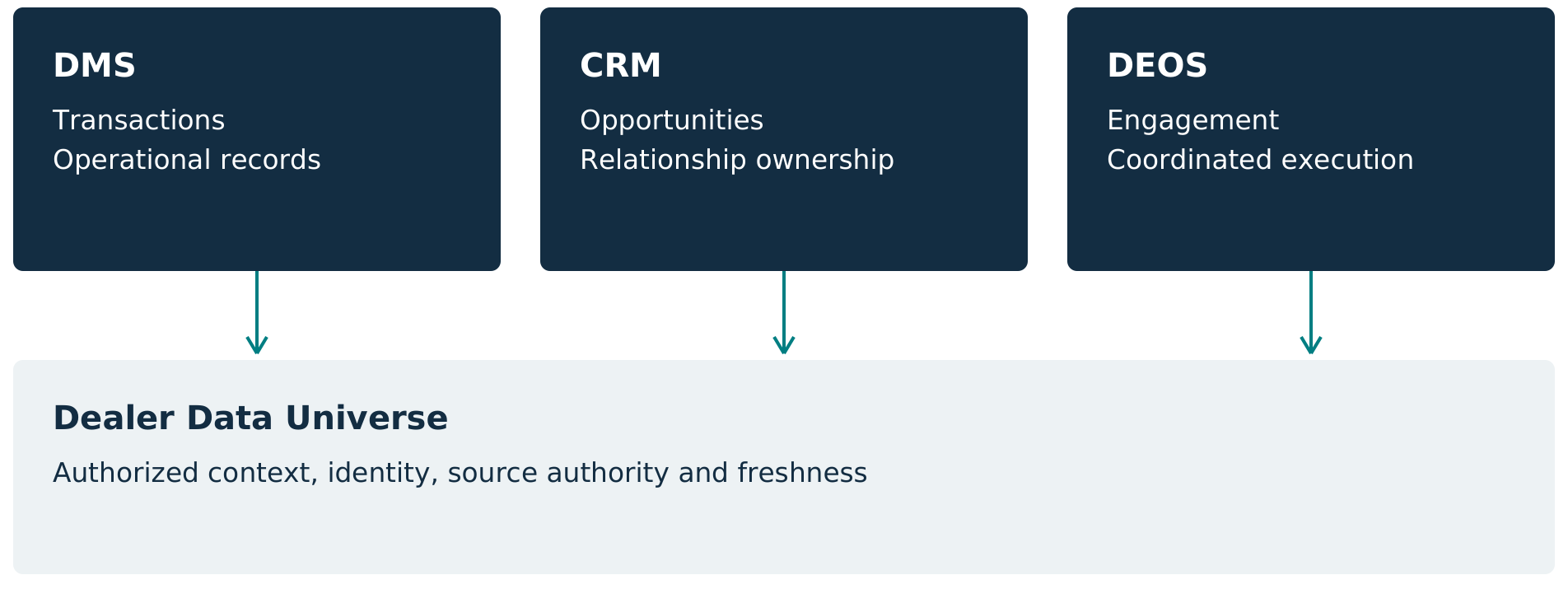
Figure 3. Three operating roles and a governed data foundation. Arrows indicate authorized exchange, not unrestricted write access.
The boundaries are intentionally permeable. A CRM may contain engagement functionality; a DMS may offer customer communications; a CDP may unify identities and activate audiences. SAP’s CDP documentation describes persistent, unified customer data available to other systems.19 The DEOS contribution is an explicit responsibility for automotive dealerships functioning as a largely autonomous coordinated execution and feedback engine of all customers for the dealership across all sales and service activities. Its necessity is assessed as a capability gap, given that the DMS is strictly an operations system, and a CRM is centric to sales. The DEOS operates as a holistic customer engagement model for the life of the customer with the dealership.
Internal and external engagement share context but need different permissions. Internally, a service manager can ask which declined repairs are eligible for follow-up and may prompt the DEOS to trigger a media campaign to all eligible customers. Externally, the system may deliver an approved reminder and manage the response. The first activity is information access; the second acts on a customer relationship. They require separate authorization, logging, and success criteria.
08 The Dealer Data Universe
The Dealer Data Universe, or DDU, is a governed, dealership-specific information environment that relates authorized operational records, customer opportunities and engagement history. It should be considered the single source of truth of dealership, customer, vehicle and business information. It provides the context needed for analysis and permitted action. It is a logical data environment; implementation may combine replicated data, event streams and federated queries. It need not copy every source record into one database but instead serve as a ubiquitous source of connected information. A useful DDU includes customer and household identities, vehicle identifiers and ownership periods, inventory status, sales opportunities, service events, approved offers, channel preferences and engagement outcomes. Each entity must retain source identifiers and provenance. A person is not the same entity as a household, a VIN is not permanent evidence of current ownership, and an email address may be shared. Incorrect entity joins can turn personalization into disclosure of another customer’s information.
The architecture needs a field-level authority map. The DMS may be authoritative for a posted transaction; the CRM for salesperson assignment; a scheduling service for appointment capacity; and a consent ledger for channel permission. When fields conflict, the system should apply a published precedence rule or request resolution. It should not allow a language model to select whichever value appears most plausible. Freshness of data is equally important. An inventory response should identify its update time. A service offer should not rely on a repair that has already been completed. If a feed becomes stale, dependent actions should pause or fall back to human review. The DDU should expose completeness and freshness indicators so employees can judge whether an answer is usable.
A shared schema reduces translation costs but does not eliminate implementation work. STAR’s domain model provides relevant industry alignment.6 The proposed DDU should reuse applicable standards, document extensions and maintain stable entity keys. Access to source data must still be negotiated and technically implemented. API certification, export rights, integration fees and permissible use can materially change deployment scope. The DDU connects authorized context while preserving restricted access, limited retention and export rights. Sensitive financial and personnel records require compartmentalization. Consolidation must preserve the dealer’s ability to disengage from a provider.
09 Five Layers From Data to Action
The five-layer architecture translates the operating model into separable technical responsibilities.
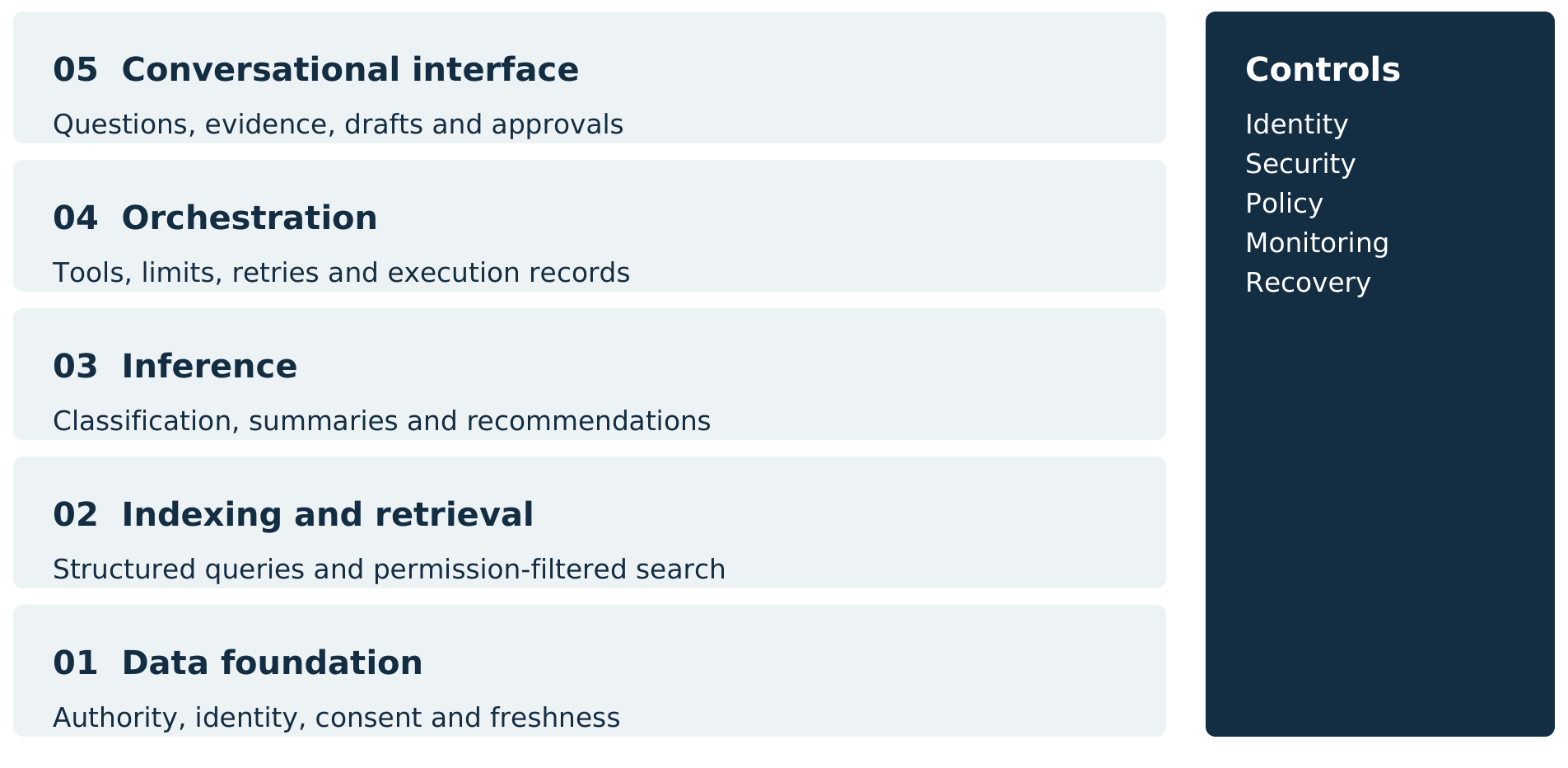
Figure 4. The proposed Hybrid Autonomous Dealer Stack. The side control plane applies across all five layers.
These layers can be packaged within a DEOS platform or delivered through coordinated services. Security, policy, identity, observability, and recovery apply across every layer. The CUI is the access surface; the Dealer Agent is the authorized execution capability behind it.
Layer 1 is the DDU foundation. Connectors ingest, or query approved sources, preserve record authority, resolve identities, and maintain consent, freshness, and provenance. Reliable reconciliation is a prerequisite for downstream inference. A successful connector test must establish what can be read or changed, not merely that a connection exists.
Layer 2 is indexing and retrieval. Structured queries serve exact numerical and transactional questions. Search indexes and vector retrieval support documents, notes, and semantic questions. Retrieval-augmented generation combines a model with information retrieved from external memory, an approach described by Lewis and colleagues.20 Retrieval can improve grounding, but it does not guarantee correctness. Permission filters must operate before restricted information reaches a model.
Layer 3 is inference. Models classify intent, summarize context, draft communications, and support recommendations. Use validated data and deterministic tools for exact prices, taxes, payment calculations, and scheduling constraints. Model selection can differ by task, cost, latency, and risk. The system should record model versions and test performance after a material change.
Layer 4 is orchestration and application logic. A workflow engine selects approved tools, enforces permissions and spending limits, manages approval states, handles retries, and records execution. It must prevent a duplicated event from producing a duplicated message or booking. The permission to analyze an audience must not automatically include the permission to publish a campaign.
Layer 5 is the CUI (conversational user interface). Employees can ask questions through web or mobile interfaces, inspect evidence, revise drafts, and approve eligible actions. The interface should show the store and data scope in use, the requested action and its status. It must clearly distinguish a proposed plan from a completed transaction and disclose when an operation failed.
NIST’s Generative AI Profile identifies risks associated with confabulation, information integrity, privacy, and human interaction.18 For this reference architecture, the implication is that fluency cannot act as a substitute for evidence. An unsupported answer should be withheld, qualified, or routed for review. A system must never report that a message was sent or a repair order changed merely because the model generated a statement describing that action.
10 The Dealer Agent in Daily Work
The Dealer Agent, or DA, is similar to the enabled agent when using applications such as ChatGPT or Claude. It is a role-aware service that converts employee requests into evidence-backed answers and authorized tasks. Its authority is inherited from the user’s role, store scope, and workflow policy. A dealer principal, controller, salesperson, and technician may use the same interface while receiving different information and execution options. Conversational access simplifies interaction; it does not flatten the organization’s authority structure.
A Service Manager could request: identify customers who declined eligible maintenance in the last 90 days and have not returned, then prepare a reminder campaign and authorize sending it. The agent should first define the period, repair categories, completed-service exclusions, and permitted audience. It should calculate the population from structured records, show the source timestamps, and create a draft. Launching the reminder is a separate step requiring the appropriate approval or an existing bounded authorization.
A General Manager might ask why service appointments declined this week. The DA can compare available bookings, capacity, campaign activity, and cancellation patterns, then present possible explanations. It must distinguish correlation from causal attribution. A coincident drop in outreach does not prove that it caused fewer appointments. A controller asking about campaign economics needs consistent cost allocation and margin definitions rather than simple, generated arithmetic.
Sales personnel could ask for a customer’s authorized interaction history or initiate an approved follow-up. A technician could retrieve relevant work instructions or summarize an assigned vehicle’s service history within access limits. The agent should not authorize a repair on behalf of a customer, bypass the service advisor’s workflow, or turn an unverified model response into a diagnostic determination. Available DMS write operations are implementation-specific.
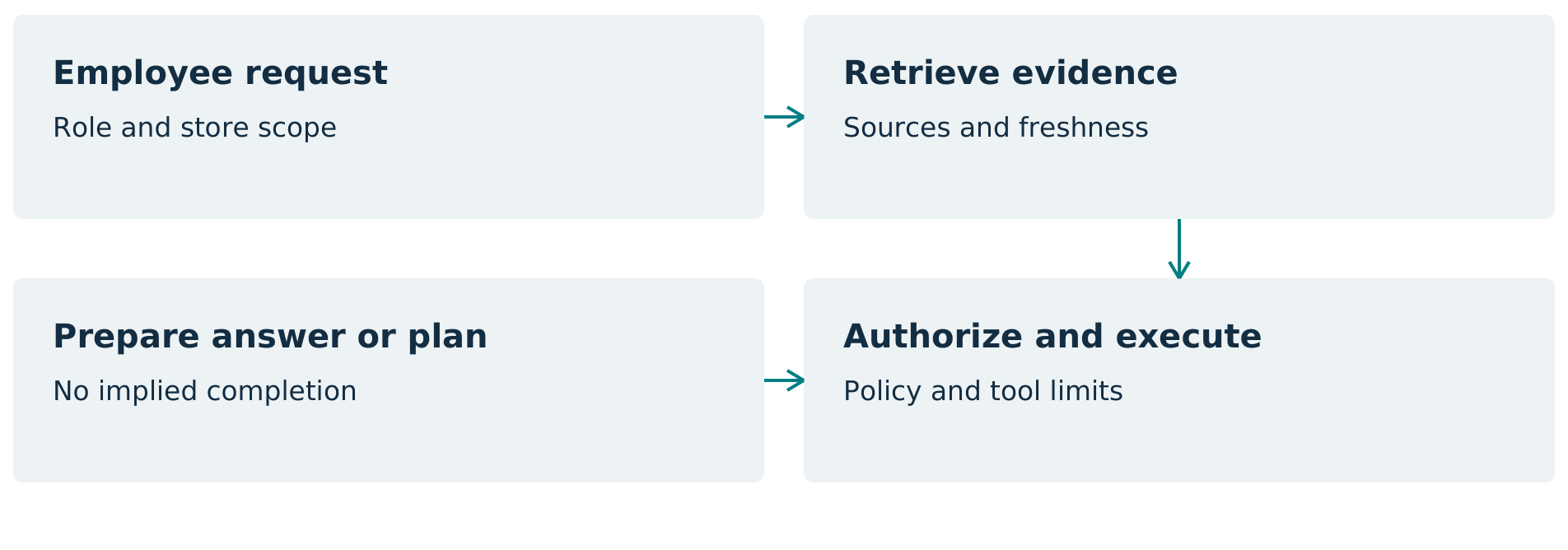
Figure 5. A bounded Dealer Agent request. Evidence retrieval and execution authorization are separate checks.
An effective DA uses narrow tools rather than general access to production databases. OWASP (Open Worldwide [Web] Application Security Project) identifies excessive functionality, permissions and autonomy as causes of excessive agency.21 The architectural response is explicit tool scopes, downstream authorization, and approval for high-impact actions. Retrieved messages and documents are data, not instructions that can expand the agent’s authority. Each committed action should identify its initiating employee or approved workflow, policy version, supporting records, and execution result. Recovery requires an exception queue, a stop mechanism and a procedure for correcting affected records or communications.
11 Coordinating the Customer Lifecycle
External engagement of customers is a closed-loop operating function. It begins with an event or condition, checks whether contact is appropriate, selects an approved message and channel, delivers the communication, evaluates the reply or outcome and determines what follows. The relevant unit of coordination is the customer’s current situation, not an isolated campaign list. Although there are nearly 200 daily signals occurring with customers across an active dealership, the following 22 touchpoints are the authors’ illustrative lifecycle taxonomy reflecting an industry best practice and not a requirement. Each deployment must map the taxonomy to its available data, business policy, and customer permissions.
Table 3. Twenty-two (general) lifecycle touchpoints
| Moment | Purpose and control |
|---|---|
| 1 Anonymous website visit | Provide useful information; identify only when lawful. |
| 2 Identified shopper | Resolve identity and record preferences. |
| 3 Inventory interest | Use current stock and approved vehicle facts. |
| 4 Customer inquiry | Answer or route with preserved context. |
| 5 Lead response | Coordinate follow-up and CRM ownership. |
| 6 Sales appointment | Confirm details and capacity. |
| 7 Missed appointment | Offer appropriate rescheduling. |
| 8 Trade-in interest | Route for appraisal and validated estimates. |
| 9 Purchase decision | Support a human-approved offer. |
| 10 Vehicle delivery | Prepare instructions and handoff. |
| 11 Management welcome | Deliver an authorized dealer greeting. |
| 12 Early ownership | Explain features and assistance options. |
| 13 First service | Provide appropriate maintenance guidance. |
| 14 Scheduled service | Confirm logistics and appointment details. |
| 15 Declined repair | Use the actual finding and recorded decision. |
| 16 Overdue service | Check ownership and completed-work exclusions. |
| 17 Safety recall | Use authoritative eligibility and remedy facts. |
| 18 Lost-service reactivation | Respect preferences and contact limits. |
| 19 Satisfaction and feedback | Escalate a complaint to accountable staff. |
| 20 Service-to-sales opportunity | Validate equity and offer assumptions. |
| 21 Upgrade or lease maturity | Use accurate terms and approved options. |
| 22 Next purchase or referral | Invite only appropriate relationship follow-up. |
View Table 3 as printed
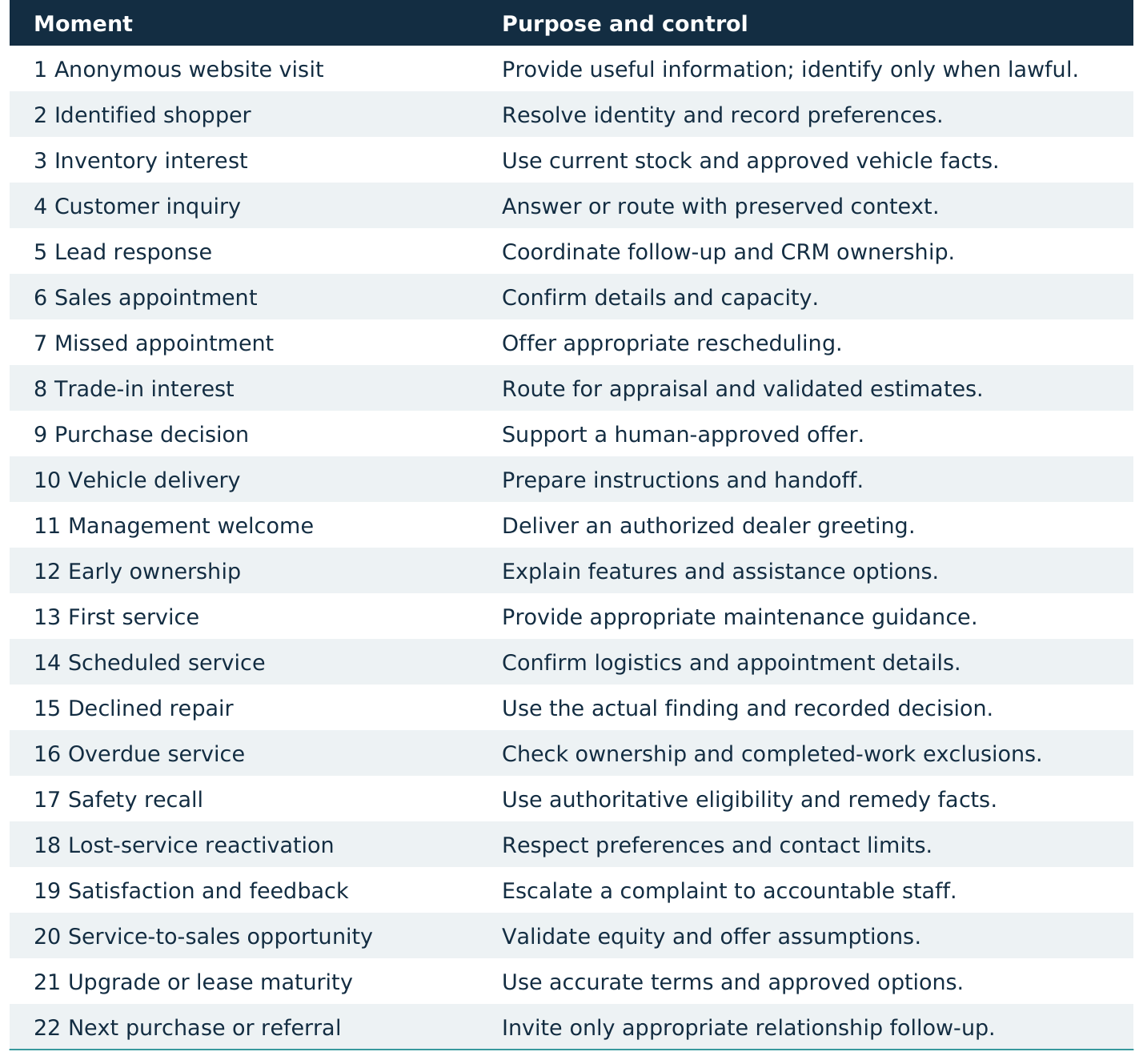
All of these configurations (including hundreds of sub-signals) should run from the dealership DEOS as a single source of customer engagement and contact.
A configurable sequence may combine personalized video email, conversational AI SMS, permitted conversational AI voice calls, direct mail with QR links (to personalized video messages), social publishing of video content, and eligible connected-TV or over-the-top distribution to video content. Configurability should include channel enablement, wait times, branching, contact limits, stop conditions, and human escalation. A dealer must be able to disable a channel without breaking the record of the customer’s journey.
A one-to-one message and a paid-media impression have different delivery and attribution properties. A mailed QR code can link to a personalized landing page, but the link must not expose sensitive data to anyone who obtains it. Social and OTT campaigns may use platform-matched audiences under applicable terms; they do not guarantee that any named DDU customer can be reached or that a particular impression caused a purchase.
Content generation from the DEOS should use dealer assets, approved scripts, OEM vehicle imagery, authorized personnel replicas or original animated presenters. Rights, disclosures, and review must be built into the content workflow. A cloned voice or likeness requires documented authorization and clear limits on use. Character-based creative should be original, with no implied affiliation with an entertainment brand. Creative novelty is a testable option, not an assumed improvement in trust or conversion.
Customers should be protected by global contact limits across workflows. A new lead, a service-due signal and a trade estimate must not create three competing conversations. A negative response, a sold vehicle, or a completed repair should change subsequent action promptly. Attribution should connect contact activity to actual appointments, shows, completed work and sales while avoiding repeated credit for the same outcome.
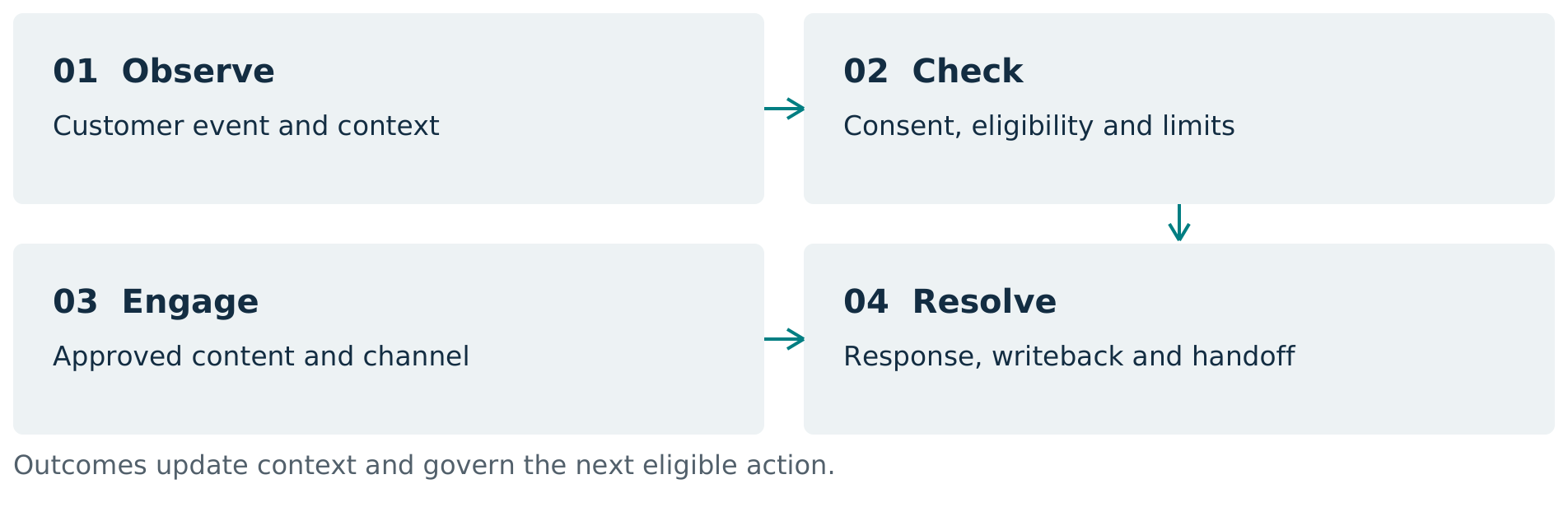
Figure 6. Engagement as a feedback loop. Consent, policy and contact limits apply before delivery and after a response.
Sequence selection should be tested rather than declared universally optimal. An SMS asking whether a customer would welcome a call may be less intrusive in some contexts, but no evidence reviewed here shows it guarantees retention. Sending that initial SMS also needs its own permissible basis; it does not automatically cure a consent deficiency for a later AI voice call.
A Reliable Transfer to Human Assistance
The Hybrid Autonomous Dealer model depends on an explicit handoff protocol. A transfer should preserve verified identity, the customer’s stated goal, relevant conversation history, current offers, consent status, completed actions, and unresolved questions.
The customer should receive a clear indication that a person is taking over. A named queue or owner must acknowledge receipt, and the autonomous workflow should stop competing outreach while the case is assigned. Where no person is available, the system should offer an accurate response time or booking option rather than imply immediate assistance.
Acceptance testing should measure successful transfer, time to human response, repeated-question frequency, and unresolved cases. Trigger conditions should include requests for human contact, uncertainty, repeated misunderstandings, complaints, and actions beyond delegated authority. A natural-sounding voice or expressed customer empathy does not resolve a broken transfer. The design objective is continuity and appropriate disclosure, with a graceful fallback when automation or staffing is unavailable.
12 Trust And Bounded Commercial Authority
The December 2023 Chevrolet of Watsonville episode is instructive when described accurately. A manipulated chatbot produced a response purporting to offer a ~$70,000 Chevy Tahoe for $1. The Chicago Automobile Trade Association reported the exchange and the dealer’s deactivation of the chatbot; Fullpath published its own account of adversarial attempts and subsequent measures.22,23 The reviewed evidence does not establish that the Tahoe was in fact ever sold for $1, or that a court found the exchange legally binding. The lesson is inadequate control over a customer-facing representation, not a proven contract outcome. Consumer Reports’ August 2026 reporting describes AI voice agents used for appointment setting and service upsells, including persistent sales behavior observed in demonstration calls.24 It provides qualitative evidence of consumer-facing risks, not a measured rate of customers lost to AI calls, which is an important metric to consider. An operating model should monitor complaints, opt-outs, and escalation as carefully as appointments or gross revenue. Commercial safeguards should be enforced outside the model. Prices and inventory should come from authoritative records. Offer expiration, exclusions, and approval limits should be machine-checkable. A repair recommendation should distinguish an OEM schedule, a technician finding, and a promotional offer. A safety recall notice should not be contingent on purchase of additional services.
Consequential commitments should require appropriately authorized personnel or a separately approved deterministic workflow. Governance is already an automotive industry concern. STAR’s February 2026 AI guidance emphasizes critical-workflow review, least privilege, vendor diligence, incident response, and limited pilots.25 This paper incorporates those principles into the definition of autonomy. Controls are operating infrastructure; they cannot be treated as an optional policy appendix after customer-facing deployment. Legal requirements vary by channel, information, and jurisdiction. The FCC’s 2024 declaratory ruling places AI-generated voices within the TCPA’s artificial or prerecorded voice framework.26 FTC guidance explains Safeguards Rule obligations for covered automobile dealers and commercial email requirements under CANSPAM.17,27 Deployment therefore needs channel-specific review, appropriate consent evidence, suppression, security, and oversight of service providers. These references identify relevant obligations; they are not a complete legal analysis or a finding that all AI calls are prohibited. The control design should include scoped credentials, multifactor authentication where appropriate, encryption, retention rules, incident response, content logs, and a rapid stop mechanism. Data supplied to a model should be limited to the task. Customer records should not become training material through an unexamined vendor default. The dealership should know which providers process its information and how to recover or export it when service ends.
13 The Stack Audit as an Adoption Blueprint
A “Stack Audit” is the proposed entry method for assessing an existing dealership technology environment before recommending consolidation as the first step to creating a Hybrid Autonomous Dealer model. It documents applications, contracts, costs, business processes, data connections, and actual use. The term is used descriptively here. The method builds on established application portfolio review and workflow analysis; it is not a claim that auditing software stacks has never been done.
Discovery should begin with actual costs, renewal dates, cancellation provisions, vendor agreements, and access rights. Interviews and workflow observation should identify activities performed outside subscribed tools, including spreadsheets and manual work. An application catalog based only on employee recollection can miss bundled modules, dormant subscriptions, usage charges, or a product another system depends on.
The next stage maps workflows to business outcomes. For each activity, the audit records its trigger, input data, human owner, rules, communication channels, system writebacks, exceptions and completion evidence. Overlap is a workflow-level finding. Two applications sending SMS does not prove that either can replace the other’s lead handling, service scheduling, or reporting, but will disclose the potential of unnecessary redundancies of costs and workflow activities.
An audit engine can compare these findings with a maintained capability catalog and flag possible duplication and cost inefficiencies. Every replacement recommendation needs a confidence level and evidence of the proposed system’s functional coverage. Unknown data access, missing cancellation terms, or an untested writeback should reduce confidence.
A DEOS specialist can facilitate discovery, but dealer approval and transparent assumptions are needed to manage the commercial conflict in recommending its own platform.
Table 4. Minimum evidence for a Stack Audit recommendation
| Audit field | Evidence required |
|---|---|
| Cost and term | Invoice amount, variable usage, renewal and cancellation rights. |
| Workflow scope | Trigger, audience, owner, channel, handoff and completion record. |
| Replacement coverage | Demonstrated capability; partial or missing functions identified. |
| Data dependency | Source rights, export, API access, latency and downstream consumers. |
| Migration risk | Retention, rollback, training and acceptance evidence. |
| Financial result | Removable spend less new cost, retained cost and transition expense. |
View Table 4 as printed
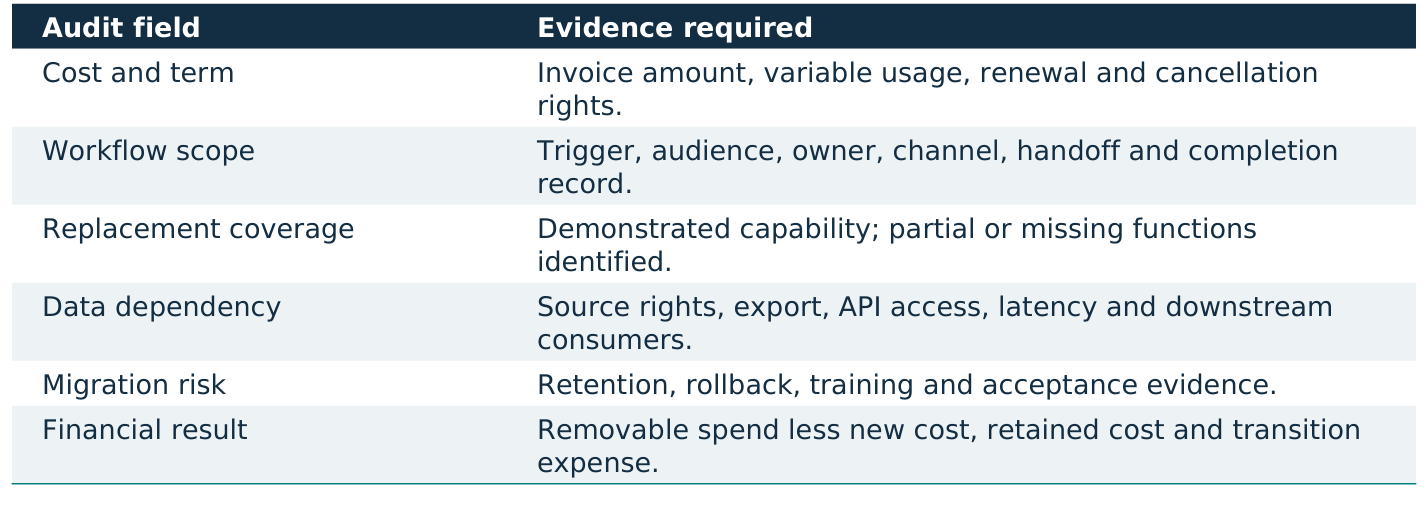
The resulting report should classify each application as either “retain,” “potentially replace,” “partially consolidate,” or “investigate”. It should show the retained functions, prerequisites for migration, expected cancellation date, and owner of the decision. The DMS and CRM as core systems should remain unless a separate, fully supported replacement program exists. A specialist function that is not reliably covered must not disappear because its subscription is inconvenient.
The audit becomes a blueprint when it connects costs and capabilities to a phased implementation.
A checkbox inventory alone cannot establish savings. The deployment must demonstrate data continuity, feature equivalence where required, employee readiness, customer protections, and successful rollback. After launch, the audit should reconcile projected subscription retirements with actual cancellations and compare baseline outcomes with observed performance.
14 Cost and Application Reduction Through Consolidation
A principal economic benefit of the Hybrid Autonomous Dealer model is the opportunity to replace overlapping applications with a coordinated engagement capability. A dealership may pay several providers to perform related functions: customer follow-up, service reminders, appointment scheduling, conversational messaging, campaign generation, and customer reactivation. Consolidating those functions can reduce recurring subscription costs while simplifying administration, integration maintenance, and workflow coordination. The Stack Audit establishes the basis for this reduction. It identifies what the dealership pays, which functions overlap, which capabilities must remain, and which applications can be retired after replacement functionality is verified. The financial opportunity comes from eliminating redundant expenditure while preserving the dealership’s required operating capabilities.
Illustrative single dealership scenario
Consider a dealership whose audited engagement and related application portfolio costs $15,000 per month across 12 applications. Following consolidation, three specialist applications remain, while one DEOS replaces the functions previously distributed across nine applications. The resulting portfolio contains four applications. The following figures are hypothetical planning assumptions, rather than market averages, vendor quotations or demonstrated deployment results. DMS and CRM costs fall outside this example and remain unchanged.
Table 5. Single dealership illustrated scenario
| Monthly cost component | Before | After |
|---|---|---|
| Applications subsequently retired | $12,500 | $0 |
| Retained specialist applications | $2,500 | $2,500 |
| Consolidated DEOS capability | $0 | $4,500 |
| Additional channel and integration usage | $0 | $500 |
| Total recurring monthly cost | $15,000 | $7,500 |
| Monthly recurring savings | $7,500 |
View Table 5 as printed
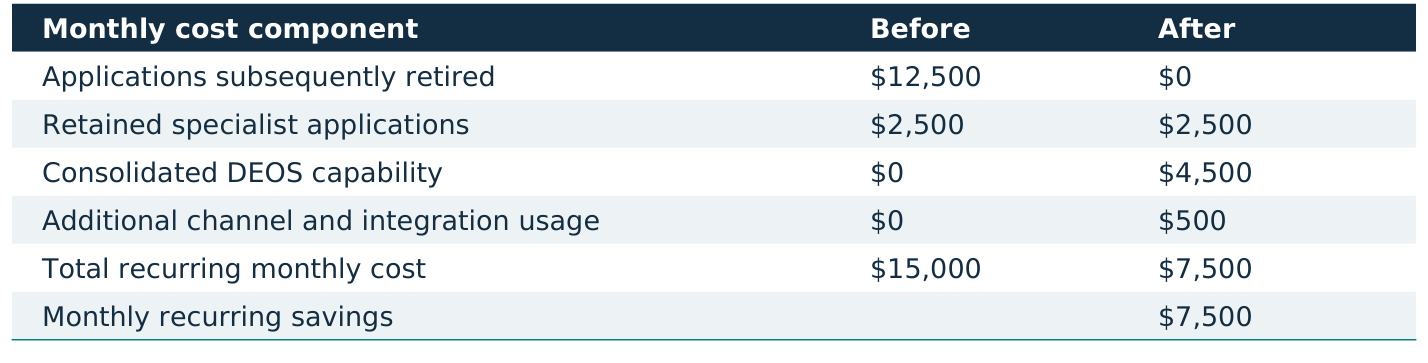

Figure 7 Illustrative recurring monthly application cost and economics (hypothetical scenario). Excludes DMS, CRM and transition expense. Authors’ hypothetical planning assumptions; not observed results.
In this scenario, the dealership reduces its defined recurring application expenditure by 50 percent and its application count from 12 to four. The savings arise because a single coordinated capability performs workflows that previously required several separately purchased products. They do not depend on assumed workforce reductions or additional vehicle sales. Once the replacement functions are operational and the former subscriptions have ended, the recurring savings accumulate as follows:
Table 6. Hypothetical consolidation economics for single dealer
| Period at consolidated cost level | Savings |
|---|---|
| One month | $7,500 |
| One quarter | $22,500 |
| One year | $90,000 |
| Three years | $270,000 |
View Table 6 as printed
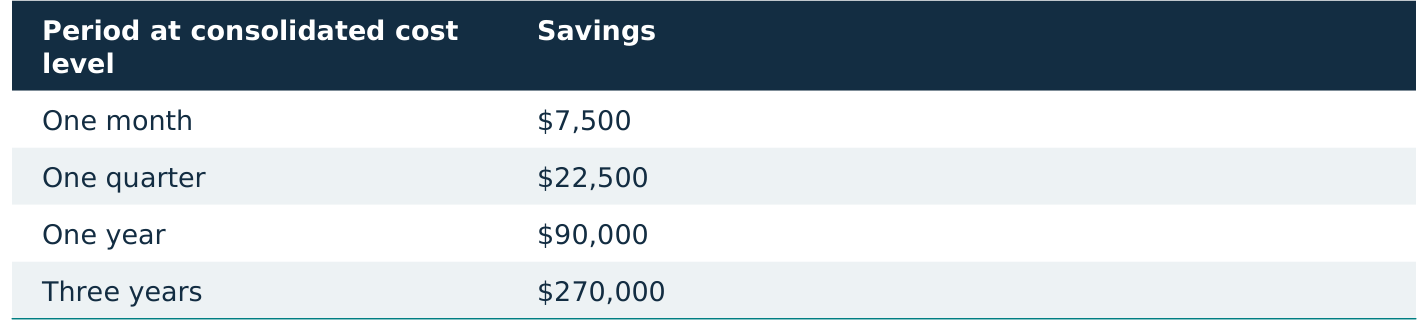
The dealership can retain these savings as operating profit or redeploy them toward customer experience, employee development, facility improvements or other business priorities. Fewer applications can also reduce the number of vendor relationships, renewal decisions and disconnected workflows that personnel must manage. These additional benefits should be measured separately from the subscription savings.
Illustrative 10-store group scenario
For a 10-store group in which each dealership achieves the same consolidation outcome, the recurring financial benefit increases to $75,000 per month and $900,000 annually.
Table 7. Hypothetical 10-store group consolidation economics
| Measure | Single dealer | 10-store group |
|---|---|---|
| Monthly cost before consolidation | $15,000 | $150,000 |
| Monthly cost after consolidation | $7,500 | $75,000 |
| Monthly recurring savings | $7,500 | $75,000 |
| Quarterly recurring savings | $22,500 | $225,000 |
| Annual recurring savings | $90,000 | $900,000 |
| Three-year recurring savings | $270,000 | $2,700,000 |
View Table 7 as printed
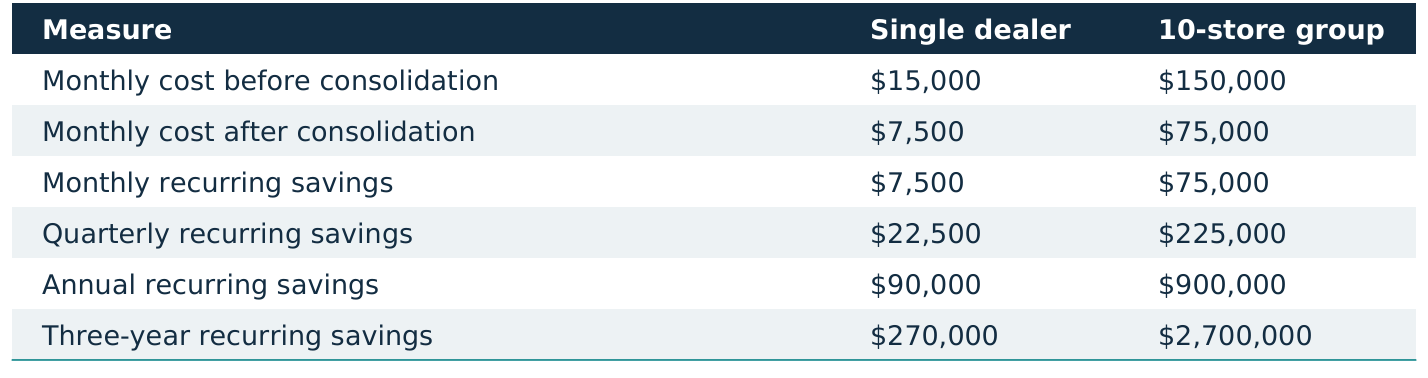
Across the group, the example reduces store-level application subscriptions from 120 to 40. These are subscription instances across rooftops, rather than 120 distinct software products. A shared operating architecture can further support consistent workflows, centralized oversight, and comparable reporting, while preserving local responsibility for offers, capacity, and customer relationships.
These projections assume equivalent savings at every store and stable recurring costs. They represent savings after consolidation is complete; deduct implementation expense, temporary subscription overlap, and cancellation timing to determine first-year net savings. Each rooftop’s Stack Audit should establish its actual opportunity, with realized savings confirmed against invoices and completed subscription retirements.
Operating leverage and the limits of scale
Application consolidation also creates an opportunity for greater operating leverage. Automating data hygiene, lead nurturing, and scheduling can allow a dealership to process more routine activity without proportionally increasing administrative labor. Subscription savings and labor capacity gains are distinct benefits: the former reduce recurring expenditure, while the latter create time that personnel can redirect toward customer relationships, complex problems, and productive work.
The objective is lower marginal coordination cost within a tested operating range. A move from 500 to 5,000 leads per day across the group represents a tenfold workload increase. Model inference, messages, calls, infrastructure, and integration charges may increase with usage, while exception rates and available showroom or service capacity determine whether additional human coverage is necessary. The business case should therefore measure recurring application savings alongside cost per completed workflow, oversight time, customer outcomes and incremental gross contribution. A successful Hybrid Autonomous Dealer model combines a smaller, more coherent application portfolio with greater capacity to handle routine work and appropriately staffed human assistance.
15 From Dealer to Hybrid Autonomous Dealer Group
A Hybrid Autonomous Dealer Group is defined here as a multi-store retail organization applying the Hybrid Autonomous Dealer model through shared data definitions, common governance and coordinated intelligence, while preserving store-level operating authority and lawful limits on information use. Group autonomy is not simply copying one store’s campaigns to every rooftop.
The group architecture must support heterogeneous DMS and CRM deployments, brands, franchises, jurisdictions, and business processes. Shared definitions of an appointment, customer, completed repair, and sold vehicle are prerequisites for meaningful comparisons. Stores should retain authoritative local records, while a group view aggregates only authorized information and transparently reconciles differences.
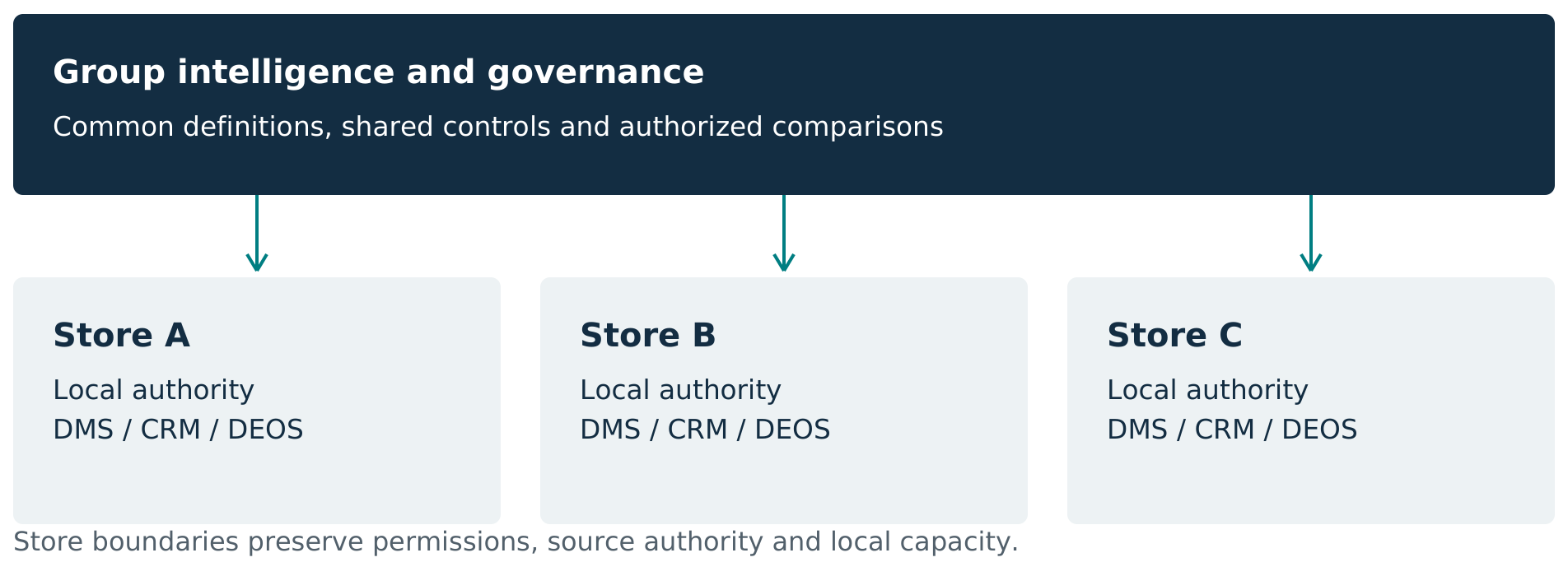
Figure 8. Group coordination with store boundaries. Shared policy does not imply unrestricted sharing of customer data or write privileges.
Central governance should set common controls for identity, security, brand standards, consent evidence, content review, model testing, and incident response. These engagement controls should be manageable in the DEOS through group settings. During initial DEOS setup and activation, local managers should configure approved offers, service capacity, contact timing, and staffing. Policy inheritance must be explicit: a local store can adjust a permitted cadence but cannot disable a mandatory suppression rule determined by group corporate. Group executives need visibility into exceptions and policy drift.
Group engagement also needs conflict resolution. A household may appear at multiple stores or own vehicles from several franchises. A group-level contact budget should prevent competing offers where coordinated treatment is appropriate and permissible. A cross-store recommendation requires clear ownership, availability, and customer permission. Shared branding does not automatically authorize every legal entity to use every customer’s records.
The Dealer Agent layer in the DEOS should support comparable management questions across the group: which stores have declining appointment show rates, where data feeds are stale, and which workflows generate unresolved exceptions. Comparison must adjust for brand, market, store size, capacity, and case mix. Ranking stores on unadjusted response rates can reward easy audiences rather than stronger operations.
Scale should follow a repeatable deployment template and store-specific acceptance. The group should validate identity resolution, record reconciliation, permissions, and escalation at each store. Integration availability and vendor agreements can prevent uniform capabilities. The model is strongest when the group knows exactly which workflows are active, restricted, or unavailable in each location of the DEOS.
16 Deployment and Operational Acceptance
The objective of packaging the Hybrid Autonomous Dealer stack is to reduce dealer implementation burden through reusable connectors, schemas, policies, and workflow templates. It is reasonable to seek rapid activation. It is not reasonable to promise overnight implementation regardless of source systems, data quality, approvals, or channel requirements. Setup speed and production readiness are different measures.
Integration can be concentrated in a managed DEOS implementation, so dealer personnel don't have to assemble each connector and workflow themselves. The five layers organize that work; they do not make API restrictions, fees, or incompatibilities disappear. DEOS agreements should specify initial setup costs to fund initial integration, system activity controls, which read and write operations are supported, and what happens after a source-system change. Subscription pricing and contractual commitments should be provided with any tiered service levels. Managed integration reduces the burden by verifying service responsibilities and compatibility, rather than proving that every legacy-system dependency has been removed.
A practical DEOS deployment and implementation sequence begins with the Stack Audit and baseline measurement pre-contracting to determine both entrance and migration value. The second phase establishes the DDU and Forensic Data Audit through source authority, reconciled identities, and all historical records. A read-only Dealer Agent pilot then tests answer quality, access scope, and freshness. This phase would also include prospective conquest customer analysis and data. The third phase should generate all communication drafts and employee-reviewed campaigns before bounded execution is activated for selected low-risk workflows. Broader channel and store expansion proceeds after the pilot meets declared acceptance criteria.
Acceptance should include correct entity joins, agreement with authoritative numerical reports, reliable source attribution, successful suppression tests, and verified scheduling, DMS, or CRM writebacks. Adversarial tests should attempt unauthorized access, price manipulation, and indirect instruction injection. Operations should also test a disconnected feed, a model outage, repeated delivery events, and a failed handoff. A live customer pilot must have a named operator and a tested stop procedure.
These procedures should be part of the integration, testing, implementation, and live deployment workflows with the DEOS specialist activation team.
The rollout should preserve service continuity. Cancel existing subscriptions only after essential replacement functions pass acceptance and required records are exported. Where a write API is unavailable, the workflow should retain a human step or a supported alternative. The Dealer Agent must disclose that boundary instead of simulating completion.
17 Measurement and Research Agenda
The Hybrid Autonomous Dealer model requires a balanced scorecard. Workflow coverage measures whether eligible events receive appropriate action. Efficiency measures include baseline human minutes, review time, exceptions, and rework. Customer measures include opt-outs, complaints, satisfaction, and requested human transfers. Business measures connect activity to shown appointments, completed repair orders, retained customers, and incremental gross contribution. Technical measures cover availability, data freshness, access violations, and execution errors.
These metrics should be defined before deployment. Appointment set rate needs an eligible population and a time window; show rate should use appointments that were due to occur; repair recovery should distinguish completed work from a booking. Automated completion should exclude cases that silently failed or needed uncounted manual correction. Costs should include channel charges, model inference, integration, vendor fees, and oversight.
A useful validation study would include multiple dealer sizes, brands, and system combinations. It would establish baseline task times and costs, use randomized customer-level holdouts where feasible, document contamination from concurrent campaigns, and measure outcomes over several service and sales cycles. The study should predefine both benefit thresholds and unacceptable increases in customer complaints or incorrect offers. Results should report distributions and failure cases, not only the best store.
Three propositions are testable:
a) First, coordinated engagement should reduce duplicate contacts and manual reconciliation compared with separate workflow tools.
b) Second, role-aware conversational access should reduce the time needed to retrieve reliable information without increasing unauthorized exposure.
c) Third, audit-led consolidation should lower total cost for a defined equivalent capability set after transition expense.
Each proposition can fail, and the implementation should be revised if evidence does not support it.
The 80:20 concept needs its own validation track. Researchers should report which tasks are eligible, how much time they consume, what fraction completes without intervention, and whether saved capacity affects customer outcomes. A later empirically supported benchmark may differ by department and store. The framework should accommodate that result rather than force an attractive ratio onto heterogeneous work.
18 Conclusion
The strongest case for a new dealership operating benchmark is the gap between expanding AI capability and coherent execution. Consumers increasingly use conversational AI tools while still valuing physical retail and human assistance. Dealers are adding AI, yet measurement and integration often lag adoption. These conditions justify evaluating an operating model that organizes automation around connected responsibilities, reliable context and accountable action.
The proposed Hybrid Autonomous Dealer brings those requirements together through DMS, CRM, and DEOS operating roles, a governed Dealer Data Universe, five technical layers, and a bounded Dealer Agent. The Hybrid Autonomous Dealer Group extends the same principles through common definitions and controlled coordination across any volume store group. Stack Audit supplies the evidence needed to decide what to retain, consolidate, and test.
The practical ambition is substantial automation of repeatable work with stronger human control over the work that matters most. Its legitimacy depends on demonstrated customer benefit, sound economics and reliable execution. The 80:20 heuristic is a starting hypothesis. The model earns its place as a useful industry benchmark only when dealer-level evidence shows where it works, where it does not, and how it manages its limits.
References
Numbered end references correspond to superscript citations in the text. Repeated citations reuse the same number. Online sources were accessed September 30, 2026. Page locators for supplied PDFs refer to the document’s printed page or, for the Consumer Reports browser export, its PDF page. Vendor sources are identified as such; proposed definitions, diagrams, audit criteria, and hypothetical economics are the authors’ synthesis.
National Automobile Dealers Association. NADA Data 2025 Full Year Report. 2026. Locator: 2025 Full-Year Report summary; 16,990 dealers, 16.2 million vehicles, sales above $1.3 trillion, more than 276 million repair orders and service/parts sales above $164 billion. https://www.nada.org/nada/newsdata/nada-data
I REVLAB INC. Dealer EngagementOS™ “Master Positioning and Messaging Bible,” September 27, 2026, sections 1, 4, 6, 9 and 10; and Hybrid Autonomous Dealer Architecture. Proprietary, unpublished commercial concept materials (source of proposed terminology and design - proprietary document).
Nexbotix. The Autonomous Dealership: AI Transforming Business Operations. February 2026, pp. 1–2 and 9. Vendor guide; establishes prior public use of the term and discussion of automation with human oversight. https://www.nexbotix.ai/wp-content/uploads/2026/02/The-Autonomous-AI-Dealership-Guide-20260218.pdf
CDK Global. Driving Forward Smoothly: CDK’s Approach to Continuous Innovation. September 19, 2025. Locator: opening DMS history and dealer workflow requirements. Vendor source; performance claims were not used as independent evidence. https://www.cdkglobal.com/insights/driving-forward-smoothly-cdks-approachcontinuous-innovation
Standards for Technology in Automotive Retail. About STAR. Undated. Locator: founding in 2001, XML messages and interoperability objectives. Industry standards organization. https://www.starstandard.org/index.php/about-us/
Standards for Technology in Automotive Retail. STAR Unveils Industry Defining Retail Automotive Domain Model to Advance Data Interoperability and AI Transformation Across the Entire Ecosystem. January 27, 2026. Locator: operational domain schemas, shared definitions and API-ready architecture. https://www.starstandard.org/index.ph p/2026/01/27/star-unveils-industry-defining-retail-automotive-domain-model-to-advance-datainteroperability-and-ai -transformation-across-the-entire-ecosystem/
KPMG International. The Future of Automotive: Changing the Way Cars Are Built Used and Sold in a Connected World. 2023. Supplied PDF, pp. 18–21, connected enterprise capabilities. Historical strategic analysis; earlier forecasts were not treated as current observed outcomes. Public companion edition linked below. https://assets.kp mg.com/content/dam/kpmg/xx/pdf/2023/09/future-of-connected-enterprise-for-automotive-v2web-sept-2023.pdf
Pew Research Center. Americans and AI 2026: Chatbots Smart Devices and Views on Impact. June 17, 2026. Locator: survey methods; chatbot use, frequency, brands and skepticism. Survey of 5,119 U.S. adults, February 17–23, 2026. https://www.pewresearch.org/internet/2026/06/17/americans-and-ai-2026-chatbots-smart-devicesand- views-on-impact/
Cox Automotive. Cox Automotive Car Buyer Journey Study Finds Efficiency Digital Tools and AI Drive Record Satisfaction. January 13, 2026. Locator: findings 3 and 4, AI usage and omnichannel preferences. 2025 study of approximately 2,300 buyers. Automotive service provider survey; descriptive associations. https://www.coxautoinc. com/insights/cox-automotive-car-buyer-journey-study-finds-efficiency-digital-toolsand-ai-drive-record-satisfaction/
Cox Automotive. New Cox Automotive AI in Auto Retail Tracker Finds Growing Gap Between Dealers and AI Powered Car Shoppers. August 11, 2026. Locator: baseline findings and methodology. Q2: 483 franchise/independent dealers and 1,502 in-market consumers; Q1: 504 dealers and 1,505 consumers. Most reported figures are Q2. Provider-sponsored, self-reported survey. https://www.coxautoinc.com/press-releases/new-cox-automotive-ai-in-auto-retail-tracker/
KPMG International. 25th Annual Global Automotive Executive Survey: Reassert Dominance A Leadership Blueprint for Future Success. August 2025. Supplied PDF, pp. 3 and 35: 775 global executives and recommendations to audit touchpoints, remove duplication and integrate customer views. https://kpmg.com/xx/en/ourinsights/transformation/annual-global-automotive-executive-survey.html
KPMG International. KPMG Global Tech Report 2026 Automotive Part One. May 2026. Supplied PDF, pp. 5– 6 and 15: architecture, legacy friction and methodology. 258 technology leaders across 22 countries/territories at organizations with revenue above $1 billion; manufacturing, supplier and mobility segments. https://assets.kpmg.com/content/dam/kpmgsites/xx/pdf/2026/05/global-tech-report-2026-automotive.pdf
Epsilon Data Management LLC. The State of AI in Marketing 2026 Benchmark Study: Marketing’s AI Inflection Point. 2026. Supplied PDF, pp. 7–8, 30–31 and 35. Methodology identifies n=257 and describes approximately 250 U.S. marketers surveyed with Fuld Inc. in May 2026 across five industries. Marketing provider research; not a dealership sample. https://www.epsilon.com/us/insights/resources/2026-benchmark-study-marketings-ai-inflection-point\
Impel. Solution Overview. Undated, reviewed September 30, 2026. Locator: AI operating system, sales, service, marketing and customer lifecycle solutions. Vendor capability descriptions; not independent performance verification. https://impel.ai/solution-overview/
Fullpath. ChatGPT 4 Integration for Car Dealers. Undated, reviewed September 30, 2026. Locator: data-rich lead generation, appointment booking and FAQ on its proprietary CDXP data layer and hallucinations. Vendor documentation; not an intellectual property assessment. https://www.fullpath.com/chatgpt-4-for-car-dealers/
Brynjolfsson E, Li D, Raymond LR. Generative AI at Work. NBER Working Paper 31161, April 2023, original working-paper version. Abstract: 5,179 customer support agents; approximately 14 percent average increase in issues resolved per hour. Later versions may report revised estimates. Non-automotive study. https://www.nber.org/system/files/working_papers/w31161/revisions/w31161.rev0.pdf
Federal Trade Commission. Automobile Dealers and the FTC’s Safeguards Rule Frequently Asked Questions. Undated, reviewed September 30, 2026. Locator: A1–A4 and B1; covered dealers, written security programs and distinction from privacy obligations. FTC staff guidance. https://www.ftc.gov/business-guidance/resources/automobil e-dealers-ftcs-safeguards-rule-frequently-asked-questions
National Institute of Standards and Technology. Artificial Intelligence Risk Management Framework Generative Artificial Intelligence Profile. NIST AI 600-1, July 2024. Locator: section 2, risks including confabulation, data privacy, human AI configuration and information integrity. DOI 10.6028/NIST.AI.600-1. https://doi.org/10.6028/NIST.AI.600-1
SAP. Introducing Customer Data Platform. SAP Learning, undated. Locator: CDP definition and distinction from delivery platforms. Primary software education documentation. https://learning.sap.com/courses/exploring-sap-cust omer-data-platform-essentials/introducing-customer-data-platform
Lewis P, Perez E, Piktus A, Petroni F, Karpukhin V, Goyal N, Küttler H, Lewis M, Yih WT, Rocktäschel T, Riedel S, Kiela D. Retrieval Augmented Generation for Knowledge Intensive NLP Tasks. Advances in Neural Information Processing Systems 33, 2020, pp. 9459–9474. Locator: abstract and model architecture. DOI 10.48550/arXiv.2005.11401. https://arxiv.org/abs/2005.11401
OWASP GenAI Security Project. LLM06 2025 Excessive Agency. 2025. Locator: root causes and prevention strategies; narrow functionality, least privilege, user context, approval and downstream authorization. https://genai.owasp.org/llmrisk/llm062025-excessive-agency/
Chicago Automobile Trade Association. Chevrolet Dealer’s Chatbot Agrees to Sell Tahoe for 1 Dollar. December 22, 2023. Locator: description of manipulated instructions, chatbot response and subsequent deactivation. Trade reporting, not a legal determination. https://www.cata.info/news-and-announcements/13293627
Horwitz A. What Really Happened When Fullpath’s ChatGPT Chatbot Went Viral. Fullpath, December 21, 2023. Vendor account of deliberate manipulation, disclaimers and mitigation. Its quantitative defense was not adopted as independently verified evidence. https://www.fullpath.com/blog/what-really-happened-when-fullpaths-chatgpt-chatbot-went-viral/
Barry K. How Car Dealerships Are Using AI to Upsell Service. Consumer Reports, August 20, 2026. Supplied browser-export PDF, pp. 3–7: voice agents, demonstration calls, upsells and consumer advice. Qualitative reporting, not an attrition study. https://www.consumerreports.org/cars/car-maintenance/how-car-dealerships-areusing-ai-to-u psell-service-a8682263617/
Standards for Technology in Automotive Retail. Guardrails for Growth STAR Publishes Dealership AI Governance and Compliance Roadmap. February 19, 2026. Locator: critical workflow review, least privilege, vendor diligence, limited pilots and monitoring. https://www.starstandard.org/index.php/2026/02/19/guardrails-forgrowth-star-publish es-dealership-ai-governance-compliance-roadmap/
Federal Communications Commission. Implications of Artificial Intelligence Technologies on Protecting Consumers from Unwanted Robocalls and Robotexts. Declaratory Ruling FCC 24-17, CG Docket 23-362. Adopted February 2, released February 8, 2024, paragraphs 1 and 5–9. AI-generated human voices within the TCPA artificial/prerecorded voice framework. https://docs.fcc.gov/public/attachments/FCC-24-17A1_Rcd.pdf
Federal Trade Commission. CAN SPAM Act A Compliance Guide for Business. Undated, reviewed September 30, 2026. Locator: commercial email requirements, opt-outs and responsibility for delegated sending. Agency business guidance. https://www.ftc.gov/business-guidance/resources/can-spam-act-compliance-guide-business