Research
Hybrid Autonomous Dealer Model
A Dealership Operating Guide
I REVLAB INC | DEOS
November 4, 2026
01. How The Dealership Operates
The Hybrid Autonomous Dealer organizes work around three core responsibilities. The DMS maintains operational records, the CRM manages sales opportunities, and DEOS coordinates engagement across the customer relationship. Staff use their departmental applications and a role-aware Dealer Agent to understand activity, direct permitted work, and resolve exceptions. Connected records give each authorized interaction the context of what has already happened.
A principal begins the day with an operating brief. It identifies performance against objectives, material changes since yesterday, and decisions requiring attention. Department managers receive their own authorized view. Sales continues to work its pipeline in the CRM. Service continues to manage appointments and repair orders through the DMS and scheduling tools. DEOS provides the conversational access and coordination around those activities.
The Daily Operating Rhythm
| Period | System activity | Accountable dealership activity |
|---|---|---|
| Before opening | Reconcile overnight records, check feed health, review responses, and assemble exception queues. | Managers confirm capacity, assignments, offers, and unresolved commitments. |
| During business | Process eligible events, maintain conversations, coordinate appointments, and record outcomes. | Staff handle arrivals, negotiations, diagnostics, approvals, and escalations. |
| At closing | Reconcile completed actions, identify failed transfers, and prepare the next-day brief. | Department owners resolve outstanding customer promises and approve necessary changes. |
| After hours | Continue enabled workflows within contact rules and available support arrangements. | Named owners receive urgent exceptions through agreed routes and hours. |
Automation runs under standing authority approved by the dealership. A service reminder can proceed when its records, permission, timing, and content satisfy that policy. An unusual price request or unresolved complaint moves to a person with the authority to decide. Managers supervise the rules and exceptions rather than reconstructing every routine interaction.
For this model, a task completes only when its intended outcome is confirmed or an accountable person accepts the next step. A generated reply, delivered message, booked appointment, shown appointment, and completed transaction are separate events. The operating record must distinguish them.
The white paper's indicative 80:20 principle applies to eligible recurring information and engagement work. The store measures eligible workload, actual completion, review effort, and exceptions before deciding how much automation it can sustain. Staffing decisions also depend on physical work, customer demand, and coverage.
02. Three Core Systems And Connected Applications
The three core systems assign responsibility within a wider application environment. F&I, inventory merchandising, website, scheduling, parts, payment, OEM, and specialist applications may operate as DMS modules, separate products, or connected services. Each retained application needs an identified purpose, source authority, access scope, and integration owner.
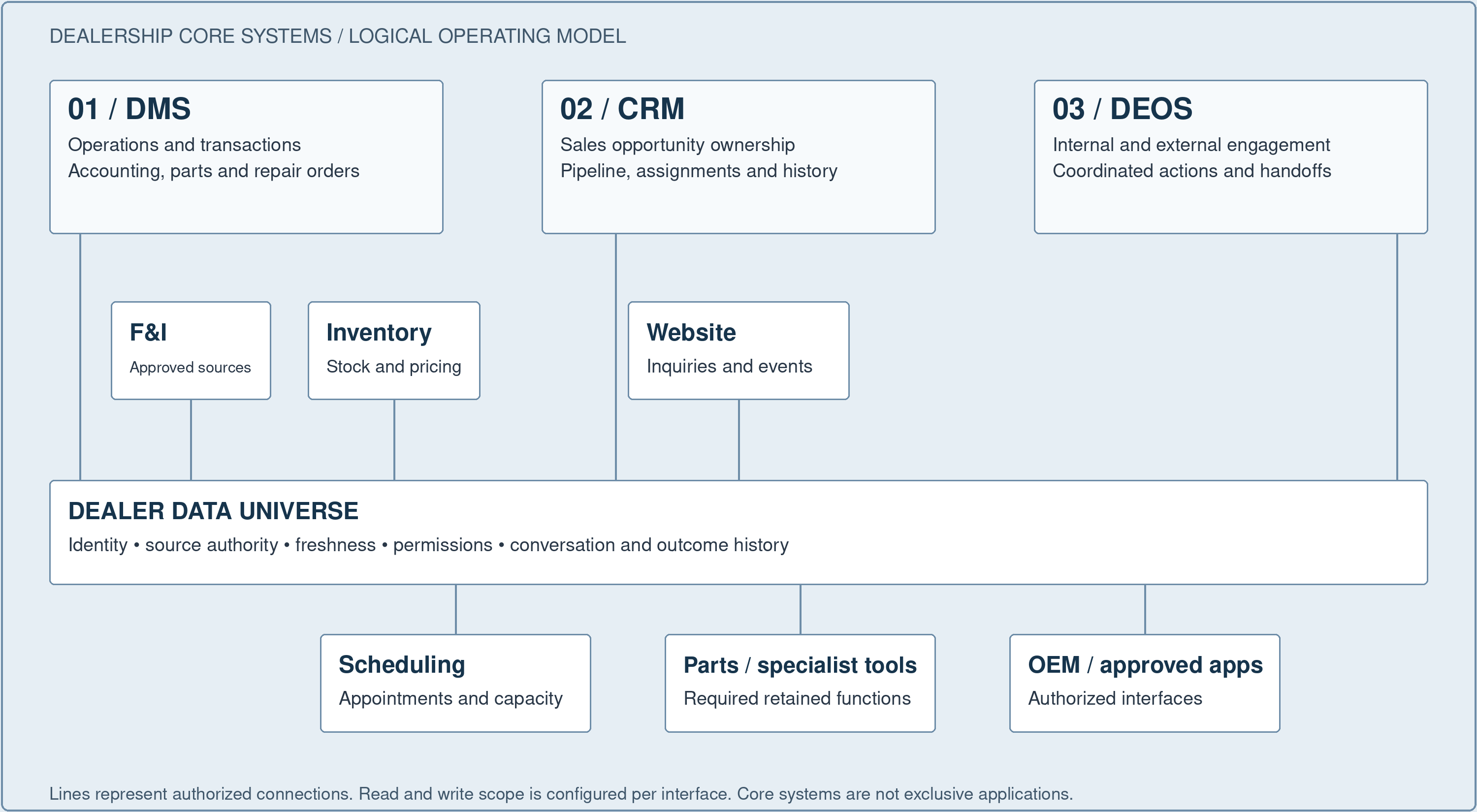
Figure 1. The three core systems and supporting applications connect to a dealership-scoped Dealer Data Universe. Lines indicate authorized interfaces. Available read and write operations are defined separately for each connection. Supporting-box placement groups business functions and does not imply a required hosting arrangement.
Which Record Controls?
| Information | Authority to establish during setup |
|---|---|
| Posted sale, repair order, accounting entry | The operational source that actually posts the transaction. |
| Lead owner and sales stage | The CRM or approved sales workflow system. |
| Vehicle availability and approved asking price | The designated inventory source, reconciled with the DMS as required. |
| Appointment capacity | The scheduler or shop-capacity application. |
| Finance terms, stipulations, and signed documents | The authorized F&I, lender, and document systems for each field. |
| Permission and contact restrictions | The designated consent and suppression ledger. |
The DDU maintains connected identities, source identifiers, ownership periods, timestamps, and permission context. It can use copied records, event streams, or approved queries into source systems. Each answer or action should be traceable to those sources. A conflict follows an agreed precedence rule or a review queue.
Access remains scoped to the dealership and staff role. Group oversight uses explicitly authorized views and common definitions. A shared brand or group relationship alone provides no basis for opening another store's customer records. An uncertain identity match is held for resolution before personalized outreach.
03. Turning Daily Signals Into Coordinated Work
The updated white paper describes nearly 200 daily customer-related signals across an active dealership. Use that as the authors' operating context when designing coverage. The actual count varies with store activity, source availability, and the definition of a distinct signal. The paper's 22 lifecycle touchpoints consolidate this activity into an illustrative best-practice taxonomy. Each dealership selects and configures the workflows relevant to its operations.
A signal is an observed event or condition. A workflow evaluates whether action is appropriate. A touchpoint describes a broader moment in the customer relationship. Several signals can belong to one touchpoint, and several signals about one customer can require one coordinated response.
A Service-To-Sales Example
A customer has a confirmed service visit tomorrow, an unresolved trade-in inquiry, and a maintenance item previously declined. These observations should produce a coordinated case with distinct departmental owners. The system preserves the appointment, routes the trade question to sales, and checks whether the declined item remains unresolved before proposing any reminder. The assigned advisor sees the relevant handoff.
The Execution Sequence
- Observe and identify. Capture the event, store, source record, customer and vehicle relationship, event time, and receipt time. Associate it with the correct records before proceeding.
- Check eligibility. Confirm data freshness, ownership, channel permission, contact limits, open cases, and completed-work exclusions. Suppress or hold a case when a required fact is missing.
- Select the next step. Choose the approved workflow, template, timing, channel, responsible department, and permitted action. Check the customer's other active workflows for conflicts.
- Execute within authority. Send an approved communication, propose an appointment, or create a task through an authorized tool. Material exceptions require the designated person's decision.
- Confirm and reconcile. Record the delivery, reply, booking result, or failed operation. Update the permitted source fields and determine whether another step remains appropriate.
Reliability In Practice
Each event needs a stable identifier so repeated delivery of the same event does not generate another message or booking. Before retrying an uncertain booking, check whether the scheduler already committed it. Use bounded retries and then escalate with the original request and failure details.
A stale inventory feed pauses dependent availability offers. A completed repair suppresses the associated recovery reminder after the completion is verified. An opt-out changes eligible actions according to its recorded scope and applicable requirements. These changes must reach every dependent workflow, with a measurable synchronization delay.
04. Departmental Workflows And Human Ownership
Sales And BDC
A new inquiry enters the CRM with a source, assigned owner, vehicle interest, and relevant permissions. DEOS retrieves current inventory facts, provides an authorized response, and continues an approved follow-up sequence. The CRM records ownership and stage. Replies requiring negotiation or a judgment call are transferred with the conversation and source context.
An appointment workflow checks availability before proposing a time and records confirmation only after the scheduler accepts it. A no-show can initiate permitted rescheduling. A sold or unavailable vehicle changes the response and may trigger approved alternatives. Staff conduct test drives, validate trades, negotiate within authority, and close the deal.
F&I And Inventory
The F&I workflow gathers approved inputs, checks document completeness, identifies outstanding stipulations, and prepares material for qualified staff. Validated calculation tools produce exact financial calculations. The record distinguishes a draft deal scenario, approved terms, lender conditions, and signed documents. Authorized people and customers make the required decisions and provide signatures.
Inventory workflows reconcile stock status, ownership, merchandising information, and approved prices across designated sources. A relevant arrival can qualify for an approved follow-up to a previously interested shopper. Staff resolve pricing conflicts, physical-condition questions, and trade valuations. A live model response alone cannot establish finance approval or override a price floor.
Service And Parts
Before outreach, the workflow checks due work, completed visits, vehicle ownership, contact eligibility, and capacity. After a booking, it supports confirmations and permitted updates. The advisor remains responsible for explaining findings and obtaining repair authorization. Technicians diagnose, repair, inspect, and perform the physical work.
A parts-arrival event can release a blocked scheduling task once the required item and job are matched. A backorder can prompt an approved customer update and an advisor task. The system confirms received parts and available capacity before promising a new completion time. Warranty, safety, and repair-quality judgments stay with qualified personnel.
Marketing And Customer Continuity
Marketing defines approved audiences, content, channel rules, and campaign objectives. DEOS coordinates delivery against the customer's existing conversations and contact limits. Personalized video and synthetic presenters use authorized assets and approved scripts. Results are reconciled to visits, completed work, and sales using declared attribution rules.
A handoff is complete when a named person or staffed queue accepts ownership. If the primary recipient is unavailable, the case follows an escalation route with an acknowledgment deadline. The customer receives an accurate statement about when assistance is available.
05. The Dealer Agent And The Staff Experience
The Dealer Agent gives staff a conversational entry point into authorized dealership information and tools. Its answers inherit the user's role, store scope, and allowed actions. The interface should identify the active dealership, reporting period, source freshness, and whether the response is an answer, proposed action, pending task, completed action, or exception.
A Simple Daily Home Page
Each role opens to a short operating brief, a prompt line, three current measures, and a list of items requiring attention. Detailed records remain available through drill-downs. Choose the three measures from the department's actual responsibilities and use explicit definitions and time periods.
| Role | Illustrative opening measures | Work requiring attention |
|---|---|---|
| Principal or GM | Dealership gross MTD, delivered units MTD, service sales MTD. | Cross-department exceptions, capacity constraints, and customer commitments. |
| Sales Manager | Delivered units MTD, today's appointments, leads awaiting staff action. | Hot inquiries, stalled deals, overdue follow-up, and failed handoffs. |
| Service Director | Service sales MTD, today's appointments, open repair orders. | Delays, promised times, repair approvals, and customer updates. |
| Parts Manager | Parts gross MTD, repair orders awaiting parts, orders needing action. | Shortages, backorders, arrivals, and uncollected special orders. |
| Marketing Director | Eligible engagement, attributed appointments, campaign-linked outcomes. | Approvals, delivery problems, suppression exceptions, and content review. |
An Answer That Staff Can Use
For “Why did appointments fall this week?”, the agent retrieves structured booking counts, cancellations, capacity, and campaign history for the requested period. It shows the comparison and identifies missing sources. Possible explanations remain hypotheses until investigated. Staff can open the supporting records or ask for the relevant departmental detail.
For “Prepare reminders for customers who declined maintenance,” the agent defines the work categories, period, exclusions, and permitted audience. It calculates the population, prepares approved content, and presents the next authorized action. An existing standing approval may permit launch. A new audience rule, discount, or channel expansion follows the required approval process.
Controlled Tools Behind The Conversation
The five layers described in the white paper separate connected data, retrieval, model interpretation, workflow execution, and the conversational interface. Permissions apply before restricted information reaches the model and again before an action executes. Narrow tools expose defined functions, such as checking a slot or creating an approved follow-up task.
Staff can ask questions freely within their access rights. Changes to production policies, pricing authority, permission rules, or integration mappings use an approved, versioned process with a record of the person making the change.
06. Oversight, Exception Handling, And Store Control
The principal assigns an operating owner for automation. A smaller store can assign that responsibility to a trained manager supported by the implementation team. A group may share specialist oversight. Department leaders retain responsibility for their offers, capacity, personnel, and customer outcomes. The controller validates financial definitions and realized economics.
Set Authority Before Activation
For each workflow, record its trigger, authorized sources, audience, permitted channels, content version, action limits, human owner, escalation deadline, and stop conditions. Define who may change each setting. A retrieval permission allows access to specified information. A campaign permission authorizes a particular execution scope. Staff must be able to inspect both.
Review By Risk And Exception
| Operating condition | Expected response | Accountable owner |
|---|---|---|
| Conflicting ownership or customer identity | Hold personalized outreach and reconcile source records. | Data owner and affected department. |
| Aged feed or unavailable connector | Pause dependent actions and identify the affected scope. | Integration owner and automation operator. |
| Unusual offer or commercial exception | Prepare the case and request an authorized decision. | Sales, service, or F&I manager. |
| Complaint or requested human assistance | Preserve context and transfer to a staffed route. | Assigned relationship owner. |
| Failed action or uncertain completion | Check destination state before retrying and escalate if unresolved. | Workflow owner and technical support. |
Managers review repeated exceptions as design problems. A workflow that repeatedly needs correction may need narrower eligibility, better data, a revised template, or a permanent human step. The operator should measure that correction effort rather than count the initial attempt as successful automation.
Keep A Recoverable Operating Record
Each action records its initiating user or standing workflow, source identifiers and times, applicable permissions, policy and content version, tool request, destination response, and final status. Sensitive information is limited to the staff who need it and retained under the applicable schedule.
The dealership needs a tested stop control for a workflow or channel, a fallback for important customer commitments, and a procedure to correct affected records. A writeback can be reversed only where the destination supports it. A sent message requires an appropriate correction process. Operators should rehearse feed loss, duplicated events, invalid permissions, and unavailable handoff recipients before expanding automation.
07. Activation, Measurement, And Expansion
Establish The Starting Position
Begin with the Stack Audit described in the white paper. Map applications, invoices, renewal dates, workflow owners, data rights, connectors, and overlapping functions. Identify the essential capabilities that must survive migration. Record baseline task effort, customer outcomes, application costs, and current failure patterns.
Build an authority map and integration register for the DDU. Validate customer and vehicle joins, field precedence, freshness thresholds, role permissions, and source reconciliation. Document what each connector can read and write and what remains a human task. Sensitive financial and personnel records receive appropriately restricted access.
Advance Through Acceptance Gates
| Gate | Evidence required before advancing |
|---|---|
| Read-only intelligence | Answers reconcile with authoritative reports, respect permissions, and expose source timestamps. |
| Draft preparation | Audiences, exclusions, content, and proposed actions meet department review criteria. |
| Bounded live execution | Consent and suppression tests pass, destination actions are confirmed, and escalation and stop procedures work. |
| Additional workflows and stores | Measured outcomes justify expansion and each new store passes its own integration and operating tests. |
Use an explicitly defined pilot population and period. Keep a named operator and a staffed exception route. Maintain existing essential services until replacement functions pass acceptance and necessary records can be exported. Connector access, data quality, and local operating conditions determine scope and timing.
Measure Completed Work And Total Cost
Track eligible-event coverage and the share completed correctly without staff intervention. Include human review time, exceptions, rework, failed transfers, opt-outs, complaints, and customer requests for a person. Reconcile appointment bookings to actual shows and repair orders to completed work. Revenue attribution uses a declared method and avoids counting the same outcome repeatedly.
Calculate net recurring benefit from genuinely removable spend and verified efficiency gains, less platform, channel, compute, integration, retained-application, and oversight costs. Account separately for transition expense. A vendor cancellation is an economic benefit only after the replacement capability works at the required standard.
A group expands through repeatable store templates, common metric definitions, and explicit local permissions. Group reporting should compare like periods and account for brand, store size, capacity, and case mix. Cross-store access and contact coordination require their own authorized scope.
08. Basis And Use
This companion operating model develops the authors' proposed architecture in The Hybrid Autonomous Dealer, Jason Bennick and Wes Reid, updated Markdown supplied November 4, 2026. Principal source sections are 06–13 and 15–17. The routines, opening measures, registers, and acceptance gates here are proposed implementation guidance. Each store sets and validates its own thresholds, supported integrations, and workflow authority.
The operating objective is coordinated execution with visible accountability. Dealership leaders should be able to see what the system knows, what it is authorized to do, what actually completed, and who owns the next decision.